


The hardness of a knife blade, measured on the Rockwell scale (HRC), is one of the most important indicators for evaluating its wear resistance and its ability to maintain a lasting edge. Choosing the right level of hardness allows you to adapt your tool to the demands of cutting and your maintenance needs.
Key points of the article
- HRC hardness determines the metal's resistance to abrasion and deformation.
- Very high hardness allows for an exceptional edge but makes the steel more brittle.
- High-end stainless steels used in kitchens typically range from 55 to 62 HRC.
What is HRC hardness?
The abbreviation HRC refers to the Rockwell C scale, a standardized method for measuring the hardness of metals and alloy steels based on the depth of penetration of a conical diamond indenter. The higher the value obtained, the harder and more wear-resistant the material.
Methods for measuring steel hardness are governed by international standards. According to ISO and AFNOR regulations on Rockwell hardness testing, sample preparation and applied force must be strictly controlled to ensure the accuracy of the result. To learn more about the physical principles of this scale, you can consult the Wikipedia page on the Rockwell hardness scale.
Comparison of mechanical properties by steel type
| Hardness | Impact resistance | Edge retention | Sharpening ease |
|---|---|---|---|
| Low (less than 55 HRC) | Very high | Low | Very easy |
| Medium (55 to 58 HRC) | Balanced | Medium to good | Easy to moderate |
| High (58 to 62 HRC) | Low to medium | Very good | Technical |
| Very high (over 62 HRC) | Very low | Exceptional | Expert |
The different hardness ranges
The different hardness levels define the possible applications for each blade and help guide the choice according to the desired robustness or precision.
Less than 55 HRC
Steels below 55 HRC are very flexible. While they are particularly resistant to impact and are unlikely to chip during intensive use, their edge dulls very quickly. They are often reserved for tools requiring great flexibility.
55 to 58 HRC
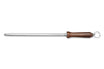
This range constitutes the standard for utility cutlery and common kitchen knives. Stainless steels in this category offer an excellent compromise between cutting edge retention and ease of maintenance, allowing for quick resharpening with a honing steel.
58 to 62 HRC
Blades in this range offer excellent edge retention. The steel is hard enough to maintain a very fine edge for long periods. However, these high-end materials require use with a soft cutting board to prevent micro-chipping.
More than 62 HRC
Steels reaching these hardness levels are extremely rigid and brittle. They are reserved for specific applications or advanced technologies. To discover our innovations in cutting edges, you can visit the page on Nanocut® technology.
Advantages and disadvantages of each level
Each hardness level involves physical trade-offs that are important to understand before making your choice.
The pros and cons
- Low hardness: Advantage of robustness against bones and impacts; disadvantage of frequent resharpening.
- Medium hardness: Advantage of versatility and easy maintenance; disadvantage of a less aggressive cut on dense materials.
- High hardness: Advantage of edge retention and precision; disadvantage of fragility requiring careful use.
If you are looking for exceptional cutting quality that revolutionizes the maintenance of your blades, we invite you to consult our models from the Evercut® collection.
What hardness for your profile
To make the right choice, it is advisable to correlate the steel's hardness with your expertise level and your kitchen maintenance habits.
Beginner
People who are learning cutting techniques tend to exert lateral pressure or hit the countertop. A range of 55 to 58 HRC is recommended to ensure the safety and resistance of the blade.
Daily use
For intensive family use, the 57 to 59 HRC range offers the best compromise, allowing for simple maintenance and excellent durability throughout preparations.
Enthusiast
For cooking enthusiasts seeking surgical precision, steels ranging from 60 to 62 HRC offer superior edge retention. To discover our collection of premium knives, visit our Excellence collections page.
Comparison of profiles and hardnesses
| Profile | HRC hardness range | Recommended knife type | Maintenance level |
|---|---|---|---|
| Beginner | 55 - 57 HRC | Utility knife | Simple (honing steel) |
| Daily use | 57 - 59 HRC | Chef's knife | Regular (honing steel) |
| Enthusiast | 60 - 62 HRC | Art knife | Expert (whetstone) |
Link between steel and hardness
The final hardness of a blade is determined by two main factors: the chemical composition of the alloy (presence of carbon, chromium, vanadium, and molybdenum) and heat treatment (quenching and tempering).
Alloy composition
A higher carbon content allows for superior hardness, while chromium ensures corrosion resistance. The majority of high-end stainless steel kitchen knives are between 55 and 62 HRC.
Should you choose maximum hardness?
Always seeking maximum hardness is not always the best solution for a kitchen knife. Very high hardness reduces the metal's toughness and increases the risk of breakage when striking a hard product.
The pursuit of balance
It is preferable to choose a hardness adapted to the intended use. A knife that will not chip when cutting a tough food will provide better satisfaction than a blade that is too rigid and brittle.
Frequently Asked Questions
What is the ideal hardness for a chef's knife?
For a versatile chef's knife, a hardness between 57 and 59 HRC offers an excellent balance between edge retention and everyday impact resistance.
Is it difficult to sharpen a 61 HRC blade?
Yes, steel of this hardness requires the use of high-quality whetstones and demands a more rigorous sharpening technique than softer steel.
Does 60 HRC guarantee that the knife will not rust?
Hardness does not determine corrosion resistance; this depends on the amount of chromium in the alloy. A 60 HRC steel can be stainless or not, depending on its specific composition.
Glossary
Hardness: The resistance of a material to penetration or surface plastic deformation.
Edge: The sharp part of the knife that performs the cutting, and whose geometry depends on the metal's hardness.
Micro-fractures: Small cracks that can appear when striking overly hard materials if the steel is too rigid.