
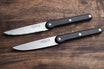
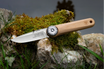
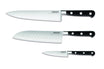

Choosing your first set of cutlery is often like stepping into a forge: the abundance of blade shapes, lengths, and profiles can intimidate enthusiasts. Yet, every angle, every curve of the steel meets a precise mechanical need in the kitchen. At TB-1648 manufactory, we believe that understanding the tool is the first step towards the perfect gesture. Whether you're looking to slice with professional speed or meticulously carve a vegetable, your knife's geometry dictates your success. This guide explores the anatomy and purpose of the main families of blades to transform your approach to the cutting board.
- Versatility is embodied by the Chef's knife or the Japanese Santoku.
- Surgical precision for vegetables belongs to the paring knife.
- Blade length and steel hardness (HRC) determine edge durability.
- Proper maintenance systematically excludes dishwasher use.
Why are there so many different knives?
The diversity of blades is not an aesthetic whim, but a response to the physics of food. Cutting a tomato, breaking down a carcass, or filleting fish puts different demands on the steel. A versatile knife can do everything, but it will rarely do it with the excellence of a specialized tool. The history of cutlery has shaped ergonomic tools adapted to the resistance of fibers and the precision of the expected gesture.
The ergonomics of the handle, the balance between the tang and the bolster, as well as the shape of the tip are designed to reduce muscle fatigue during prolonged sessions. A well-chosen knife becomes a natural extension of the cook's hand.
What are the main families of knives?
Why prefer the paring knife for precision?
It's the essential small knife in every drawer. With its short blade, typically ranging from 7 to 11 cm, it offers unparalleled maneuverability. It's not designed for large-scale board work, but for tasks performed "in hand."
- Extreme maneuverability for detailed tasks.
- Precise peeling of fruits and vegetables.
- Ideal for stemming, incising, or carving.
Is the utility knife the bridge between two worlds?
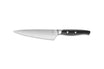
Often called a kitchen knife, its blade ranges from 11 to 15 cm. It is the preferred choice for those who find a chef's knife too imposing. Its versatility makes it an everyday ally for quick cuts, charcuterie, or small vegetables.
Why is the chef's knife the centerpiece?
The chef's knife (or Gyuto) is the ultimate multi-purpose tool, featuring a blade from 15 to 25 cm. Its main characteristic lies in its curved blade, which allows for a fluid rocking motion on the cutting board. At TB-1648, we forge these blades to offer robustness capable of handling large volumes of vegetables or dense cuts of meat.
- Rocking motion for chopping and slicing.
- Robustness suitable for professional use.
- Total versatility on the workbench.
What are the 3 virtues of the Santoku knife?
Of Japanese origin, Santoku means "three virtues": slicing, dicing, mincing. Unlike the European chef's knife, its blade is flatter and often features dimples. These create air pockets that prevent moist foods, such as fish, from sticking to the steel.
How does the carving knife ensure perfect cuts?
With a long, thin, and rigid blade, the carving knife specializes in serving large cuts of meat. It doesn't chop; it glides. Its design allows it to cut through the flesh of a roast or poultry in a single clean motion, preserving the presentation of your dishes.
How to choose the right knife for your use?
The choice should be based on two criteria: the nature of your ingredients and your personal comfort. If you primarily work with vegetables, a Santoku will be your best ally. If you handle large animal proteins, the chef's knife is essential for its cutting power.
| Model | Blade Length | Recommended Use | Steel Type |
|---|---|---|---|
| Paring | 7 to 11 cm | Peeling, incising, precision | High hardness forged steel |
| Chef | 15 to 25 cm | Chopping, slicing, versatility | Premium stainless steel |
| Santoku | 14 to 18 cm | Vegetables, fish, non-stick | Dimpled steel |
What are common beginner mistakes?
The most common mistake is using a knife for an unsuitable task. Using a paring knife on a large squash is dangerous because the lack of leverage can cause the blade to slip. Conversely, using a carving knife to chop herbs risks prematurely dulling its delicate edge.
- Never cut on hard surfaces (glass, marble, ceramic).
- Avoid contact with bones or frozen foods with blades not designed for this purpose.
- Never soak a wooden handle in water.
- Forgetting to wipe the blade immediately after washing.
How to maintain a forged knife for life?
A TB-1648 knife is designed to last for decades if a few simple rules are followed. Maintenance is not limited to sharpening; it begins immediately after use with manual cleaning in warm soapy water.
| Method | Frequency | Objective |
|---|---|---|
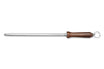
| Round honing steel | Before each use | Straighten the blade's edge |
| Whetstone (1000/3000 Grit) | Every 3 to 6 months | Recreate the edge (sharpening) |
Frequently Asked Questions about Kitchen Knives
Can kitchen knives be put in the dishwasher?
No, hand washing is mandatory to preserve the steel and the handle. Dishwasher detergents and extreme heat damage the edge and natural materials.
What is the difference between a plain edge and a serrated edge?
A plain edge provides a clean cut without tearing meat fibers. A serrated edge is designed for foods with crusts or to prevent dulling on porcelain plates.
Is it possible to use these knives if you are left-handed?
Yes, most of our blades have a symmetrical V-grind, making them perfectly suitable for both right-handed and left-handed users.