

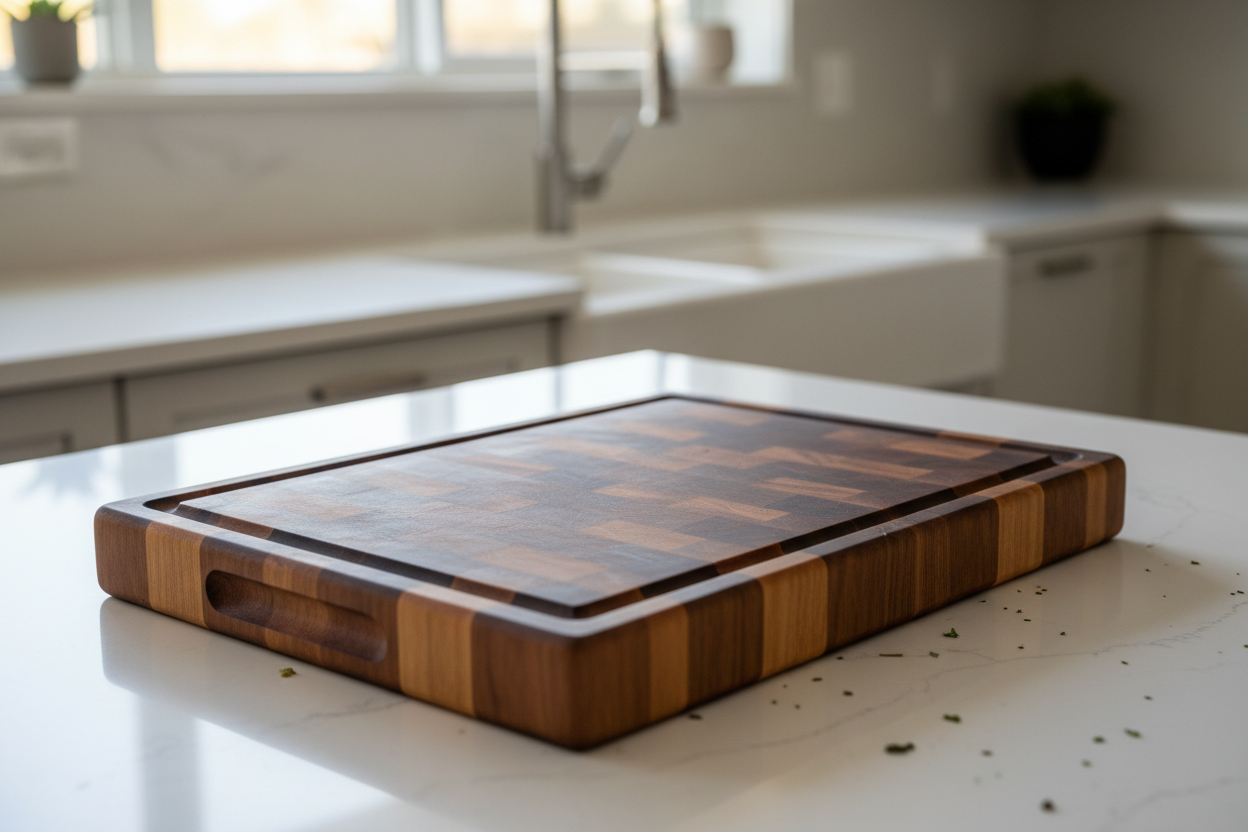
How the choice of your cutting board impacts the lifespan of your knives
Choosing a cutting surface is far from being a mere aesthetic detail for your kitchen. At TB-1648, we see daily that the longevity of your kitchen knives' edge directly depends on the material that receives the blade. Between synthetic polymers and traditional wood species, the differences in terms of hygiene, health, and technical performance are significant. This guide helps you select the ideal ally to protect your cutting tools while ensuring impeccable food safety.
Why plastic is a false good idea for your health
The steel of your knives has a much higher hardness than plastic polymers. Each pass of the blade causes abrasion of the surface, generating deep micro-scratches.
From a sanitary perspective, this phenomenon is concerning: a study suggests that a regular user can ingest up to 50g of plastic per year. Contrary to popular belief, dishwashers are not enough to dislodge bacteria lodged at the bottom of these cuts, turning your board into a reservoir for salmonella.
What are the natural advantages of wood for cutting?
Switching to wood provides an effective physical and sanitary barrier. Species like beech or walnut offer a "self-healing" structure: the fibers spread under the pressure of the edge and close after its passage, thus preventing material from being torn away.
Moreover, wood naturally contains acids and tannins that neutralize bacteria within a few hours. It is a living material that respects the fine grind of your TB-1648 knives.
| Wood species | Why choose it? | Main property |
|---|---|---|
| Beech | Local and robust choice, emblematic of the Thiers region. | Excellent value for money and rich in tannins. |
| Walnut | Softer, it offers maximum protection for your blades. | No transfer of micro-particles into food. |
| Maple | Ultra-tight grains limit liquid absorption. | Optimal impermeability to meat juices. |
Why prefer end-grain wood for your exceptional knives?
If you want to definitively banish plastic, investing in an end-grain wood board is the ultimate solution. In this configuration, the wood fibers are positioned vertically.
The blade glides between the fibers like between the bristles of a toothbrush, without ever cutting the material. The result is twofold: no material is ingested into your preparations, and your knife's edge remains operational much longer.
Frequently asked questions about cutting boards
Can a wooden cutting board be put in the dishwasher?
No, the intense heat and prolonged humidity of the dishwasher cause the wood fibers to crack. Hand washing with mild soap and immediate drying are imperative.
How to maintain your board so it lasts for years?
We recommend regularly oiling your board with a food-safe mineral oil to nourish the fibers and maintain its impermeability.
Is wood really more hygienic than plastic?
Yes, laboratory tests show that bacteria survive for a shorter time on wood than on plastic, thanks to the porous and chemical properties (tannins) of the natural material.