
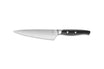
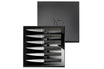
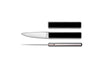


As a manufacturer and cutler since 1648, we design and test the products featured in this guide. While we are proud of our TB creations, our priority is to provide you with objective technical advice to choose the right tool for your needs.
Equipping yourself with a coherent knife set is the first step towards culinary mastery. At TB-1648, French cutlery experts since 1648, we design sets that meet the demands of both chefs and enthusiasts. This guide introduces you to the essential criteria for choosing a set tailored to your needs, from indispensable blade types to high-tech materials like Nitrox® steel. You will discover how to transform the chore of cutting into a true gestural pleasure.
What are the essential knives in a kitchen set?
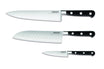
A good knife set should cover most of your needs, from millimeter precision to slicing large pieces. Most of our 5-piece blocks, such as the Brigade Bois, or our 3-piece sets, include complementary tools:
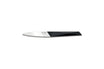
- The paring knife: With its 9 cm blade, it is the precision tool for peeling and coring.
- The chef's knife (or slicer): The versatile tool par excellence (20 cm) for chopping and slicing.
- The Santoku knife: The Japanese alternative with a dimpled blade, ideal for preventing food from sticking.
- The bread knife: Its serrated blade respects the crust without crushing the crumb.
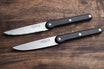
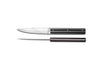
- The steak knife: Perfect for table cutting or small pieces of meat in the kitchen.
Should you choose a complete block or a 3-knife set?
This choice depends on your current equipment. A 3-knife set (Paring, Santoku, Chef), as in our Georges or Louis ranges, is ideal for acquiring the absolute essentials.
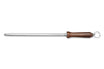
Conversely, a 5-knife block offers comprehensive equipment and secures storage on your worktop. Some collections, such as the Maestro range, even include a sharpening steel to maintain a razor-sharp edge daily.
What blade and handle material should you choose for your knives?
The choice of materials determines durability and comfort. We use high-performance steels adapted to each use:
| TB-1648 Range | Blade Material | Handle Material | Recommended Use |
|---|---|---|---|
| Maestro / Brigade Forgé | Nitrox® Steel | POM (Polyacetal) | Professional or intensive use. Very robust. |
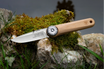
| Georges / Brigade Bois | Stainless Steel | Wood (Beech or Walnut) | Authenticity and charm of wood. Hand wash. |
| Furtif | Nitrox® Steel (PVD) | Faceted ABS | Modern design and scratch resistance. |
| Louis | Nitrox® Steel | Precious Walnut | High-tech for enthusiasts. "Jewel knife". |
How to properly maintain your knife set daily?
To extend your investment, follow these three golden rules:
Washing: Prioritize hand washing. If you use the dishwasher for synthetic handles (POM), avoid contact with other metals to prevent corrosion by "battery effect".
Storage: Never throw your knives loosely in a drawer. Use the provided block, a magnetic strip, or protective sheaths to avoid damaging the blade's edge.
Cutting surface: Cut exclusively on wood or plastic. Glass, marble, or slate are too hard and will dull your steel instantly.
Frequently Asked Questions about Knife Sets
Why oil the wooden handles of my knives?
Wood is a living material. By occasionally rubbing the handle with a little olive oil, you saturate the fibers to restore its luster and protect it from moisture.
What is the difference between a chef's knife and a Santoku?
The chef's knife is versatile for all types of cutting. The Santoku, of Japanese origin, is more suitable for mincing vegetables and fish thanks to its often dimpled blade which limits adhesion.
What is a "full tang" knife?
This means that the blade extends the entire length of the handle. This ensures robustness and perfect balance when held.