

With the multitude of kitchen knives available on the market, how do you make the right choice? You may have heard of "forged" knives and "full tang" knives, but do you really know what these terms mean and how they impact the performance and durability of your tool? Choosing the right knife ensures a reliable and high-performing ally for all your culinary preparations.
At TB Groupe, with our French cutlery heritage dating back to 1648 and rooted in the heart of Thiers, the capital of French cutlery, we have mastered the art of knife making for generations. Our commitment to "Made in France" quality drives us to share our expertise with you to help demystify these technical terms.
In this article, we will explore the fundamental differences between a forged knife and a non-forged full tang knife (often called stamped or cut). We will define each type, examine their respective advantages and disadvantages, and present concrete examples from our own TB Groupe ranges, manufactured with passion in Thiers. Get ready to discover the secrets of a perfect blade!
What is a Forged Knife? The Heritage of French Cutlery
The term "forged" immediately conjures images of ancestral craftsmanship, red-hot metal, and the sound of a hammer on an anvil. This image is not far from reality and represents the heart of cutlery tradition, especially here in Thiers, where this art has been perfected for centuries. A forged knife is much more than a simple tool; it is the result of heritage and a demanding manufacturing process.
The Art of Forging: A Blade Born from Fire and Steel
The manufacturing of a forged knife begins not with a sheet of metal, but with a massive steel bar, often round in cross-section, called a "round" or "billet." This single piece of steel is heated to very high temperatures, exceeding 1000°C, to make it malleable. This is where the transformation work begins.
The incandescent steel is then shaped by powerful hammering or pressing. If the knife is to have a bolster (the thickening between the blade and the handle), a step called "upsetting" can be performed: the center of the bar is heated and compressed to create a ball of metal that will form this robust bolster. The rest of the bar is crushed to form the rough shape of the blade on one side of the bolster, and the rough shape of the tang (the part that fits into the handle) on the other side.
The crucial element here is that the blade, the bolster (if it exists), and the tang are all formed from this single piece of steel. There is no welding between these elements, which gives the knife intrinsic strength. Once the forged blank is obtained, it is cut to its final shape ("forge blank"). This is followed by essential steps such as heat treatment (quenching to harden the steel, tempering to restore its flexibility), grinding (the sharpening that creates the edge), polishing, and final sharpening.
Recognizing a Forged Knife: Weight, Balance, and Bolster
How do you distinguish a forged knife? Several clues can guide you. First, a forged knife is often heavier than a non-forged knife of similar size. This weight comes from the unique and massive piece of steel used in its construction.
The presence of a bolster is another frequent indicator, although not all forged knives have one, and some bolsters can be added to non-forged knives. However, on a traditional forged knife, the bolster is integral, part of the same piece of steel as the blade and tang. It marks a clear and solid transition between the blade and the handle. This bolster plays an important role: it contributes to the knife's balance by adding weight towards the handle, and it acts as a guard, protecting your fingers from slipping onto the blade.
Balance is also a major asset of quality forged knives. The forging process allows for precise weight distribution, and when combined with a "full tang" construction (we will come back to this), it results in a knife that fits perfectly in hand, offering control and comfort.
Advantages of Forged Knives: French Robustness and Durability
- Robustness and Strength: This is the main advantage. Being made from a single piece, the structure is intrinsically stronger, without weak points like welds. The steel density achieved through forging also contributes to this resistance.
- Durability: A forged knife is designed to last. It is a long-term investment, a tool that can accompany you for many years in the kitchen.
- Balance: As mentioned, the balance is often exceptional, especially with an integral bolster and full tang, offering superior handling and comfort of use.
- Edge Retention: Although highly dependent on the type of steel and the quality of the heat treatment, the denser molecular structure of forged steel can potentially offer better edge retention.
- Prestige and Tradition: The forging process is associated with artisanal craftsmanship and a perceived higher quality, giving these knives a certain prestige.
However, these advantages have their drawbacks:
- Weight: They are generally heavier, which can be tiring for some users during prolonged use.
- Price: The manufacturing process being more complex and labor-intensive, forged knives are often more expensive.
- Flexibility: Their blade is generally less flexible than that of non-forged knives.
It is important to qualify the common misconception that "forged always means better." While forging provides undeniable structural advantages, particularly in terms of robustness thanks to the monobloc construction and the frequent presence of an integral bolster, it is not the only path to excellence. Modern manufacturing techniques allow for the production of very high-quality non-forged (stamped) knives. The key often lies in another crucial element of construction: the tang. A stamped knife with a full tang can achieve remarkable levels of performance and durability, while offering different characteristics, such as potentially lighter weight. Forging represents a tradition and a set of desirable attributes, but quality is judged on the overall design of the knife, including the manufacturing method and tang construction.
The Non-Forged Full Tang Knife: Performance and Modernity
Alongside the ancestral method of forging, there is a more modern and often faster approach to making knife blades: stamping or cutting. Make no mistake: "modern" or "fast" does not necessarily mean lower quality. When combined with careful design and, above all, a "full tang" construction, this method can produce extremely high-performing and durable knives.
The Birth of a Blade: Precision Cutting
Unlike a forged knife which starts from a thick steel bar, a non-forged (stamped or cut) knife begins its life from a sheet of steel. The exact shape of the blade, including the tang which will extend into the handle, is cut from this sheet using a powerful press (stamping) or a high-precision laser.
This process is generally faster and less costly in terms of raw materials and energy than forging. Once the rough shape is obtained, the blade also undergoes crucial heat treatment steps to give it its hardness, as well as grinding (sharpening), polishing, and final sharpening operations to create an effective edge. The main structural difference lies in the fact that the blade and tang are cut from a plate rather than shaped from a massive bar.
The "Full Tang": An Essential Guarantee of Strength
This is where a crucial term comes in: "full tang". The tang, let's remember, is the metal part of the blade that extends inside the handle. It is essential for solidly assembling the blade and the handle.
The term "full tang" means that this metal part extends along the entire length and often the entire width of the handle. You can often recognize it because it is visible on the back and underside of the handle, sandwiched between the two parts (scales) that form the handle, and held by rivets. This is to be distinguished from partial tangs (half tang, stub tang) where the metal only partially penetrates the handle.
It is fundamental to understand that "full tang" describes the construction of the handle and how the blade is attached to it, and not the manufacturing method of the blade itself (forged or stamped). A knife can be forged AND full tang, just as a knife can be stamped AND full tang.
Why this emphasis on full tang? Because it is an essential guarantee of quality, robustness, and balance for any type of knife, but particularly for non-forged knives. The full tang ensures an extremely solid connection between the blade and the handle, preventing the knife from bending or breaking at the joint under force. Furthermore, the weight of the metal that runs through the entire handle greatly helps to balance the weight of the blade, offering a better grip and better control.
Why Choose a Non-Forged Full Tang Knife?
- Lightness: They are generally lighter than forged knives, which can reduce fatigue during intensive or prolonged use.
- Accessibility: Since the manufacturing process is often less complex, these knives can be more affordable than their forged counterparts, while offering excellent quality if well designed.
- Flexibility: The blade, sometimes thinner, can offer a certain flexibility useful for specific tasks like filleting (although dedicated knives exist).
- Robustness and Balance (thanks to the full tang): This is the key point. Thanks to the full tang construction, these knives benefit from great solidity and very good balance, rivalling many forged knives in these aspects.
- Performance: Cutting performance (initial sharpness, edge retention) depends primarily on the quality of the steel used and the heat treatment applied, and not solely on the manufacturing method (forged vs. stamped). A high-quality stamped full tang knife can be extremely high-performing.
Potential disadvantages are:
- Absence of an integral bolster: They generally do not have a forged bolster that is integral with the blade. A bolster can sometimes be added, but it will not have the same structural function. This changes the balance point, and some users may feel a lack of finger protection.
- Perception: They may be perceived as less "noble" or traditional than forged knives by some purists.
- Attention: It is absolutely necessary to distinguish full tang stamped knives from low-end stamped knives with partial tangs, which severely lack robustness and balance.
The "full tang" construction truly acts as a quality equalizer for non-forged knives. While stamping is a simpler process than forging, the integration of a tang that runs the entire length of the handle gives the blade structural integrity and a counterbalance that was often absent from older, low-end stamped knives with partial tangs. This full tang ensures strength and balance that brings these knives closer to the structural performance of many forged models. For us at TB Groupe, offering non-forged but systematically full tang knives allows us to provide high-performance alternatives, often lighter and sometimes more accessible, without compromising the durability and comfort of use you expect from a quality French knife.
Forged vs. Full Tang Non-Forged: Which to Choose for Your Kitchen?
Now that we have explored both approaches, how do you decide which type of knife is right for you? Let's recall the essential difference: a forged knife is born from a single hot-shaped steel bar, often including the bolster, while a non-forged (stamped) knife has its shape cut from a sheet of steel. But as we have pointed out, the presence of a full tang is a decisive quality criterion for both types.
Point-by-Point Comparison
| Characteristic | Forged Knife | Full Tang Non-Forged (Stamped) Knife |
|---|---|---|
| Manufacturing Process | Hot forging of a massive piece of steel | Cutting/Stamping from a sheet of steel |
| Bolster | Often integral, forged with the blade and tang | Generally absent or added separately |
| Tang | Can be full tang (guarantee of superior quality) | Must be full tang |
| Robustness | Very high (monobloc construction) | High (if full tang) |
| Balance | Excellent | Very good (if full tang) |
| Weight | Generally heavier | Generally lighter |
| Flexibility | Less flexible | Potentially more flexible |
| Price | Generally higher | Often more affordable |
| Perception | Traditional, premium | Modern, high-performing |
Our Tips for Finding Your Ideal Knife
- What is your budget? Forged knives often represent a greater investment, while full tang stamped models can offer excellent value for money.
- What feel do you prefer in hand? Do you prefer the weight and density of a forged knife, or the lightness and agility of a full tang stamped model? It's often best to try if possible.
- What kind of use do you anticipate? For very demanding tasks or if you appreciate the presence of a bolster to guide your grip, the forged knife can be an advantage. For versatile and prolonged use, the lightness of the full tang stamped knife can be appreciated.
- How important are aesthetics and tradition to you? If you are looking for the classic chef's knife look with a distinct bolster, the forged knife is often the natural choice. If you prefer more modern and sleek lines, you will find excellent options in full tang stamped ranges.
- Do you need a flexible blade? For some very specific tasks (like thinly filleting, although a fillet knife is ideal), a stamped blade might offer a bit more flexibility.
Rest assured, whatever your choice, by opting for a recognized brand like TB Groupe, you are guaranteed to acquire a quality knife, carefully designed and benefiting from our "Made in France" expertise.
TB Groupe Excellence: "Made in France" Knives for Every Need
At TB Groupe, our long history in the cradle of French cutlery, in Thiers, has allowed us to master both traditional forging techniques and modern manufacturing processes. We are proud to offer a variety of ranges that illustrate these two approaches, always with the same commitment to quality and French manufacturing.
Forged Tradition in the Heart of Thiers: Our Exceptional Ranges
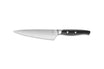
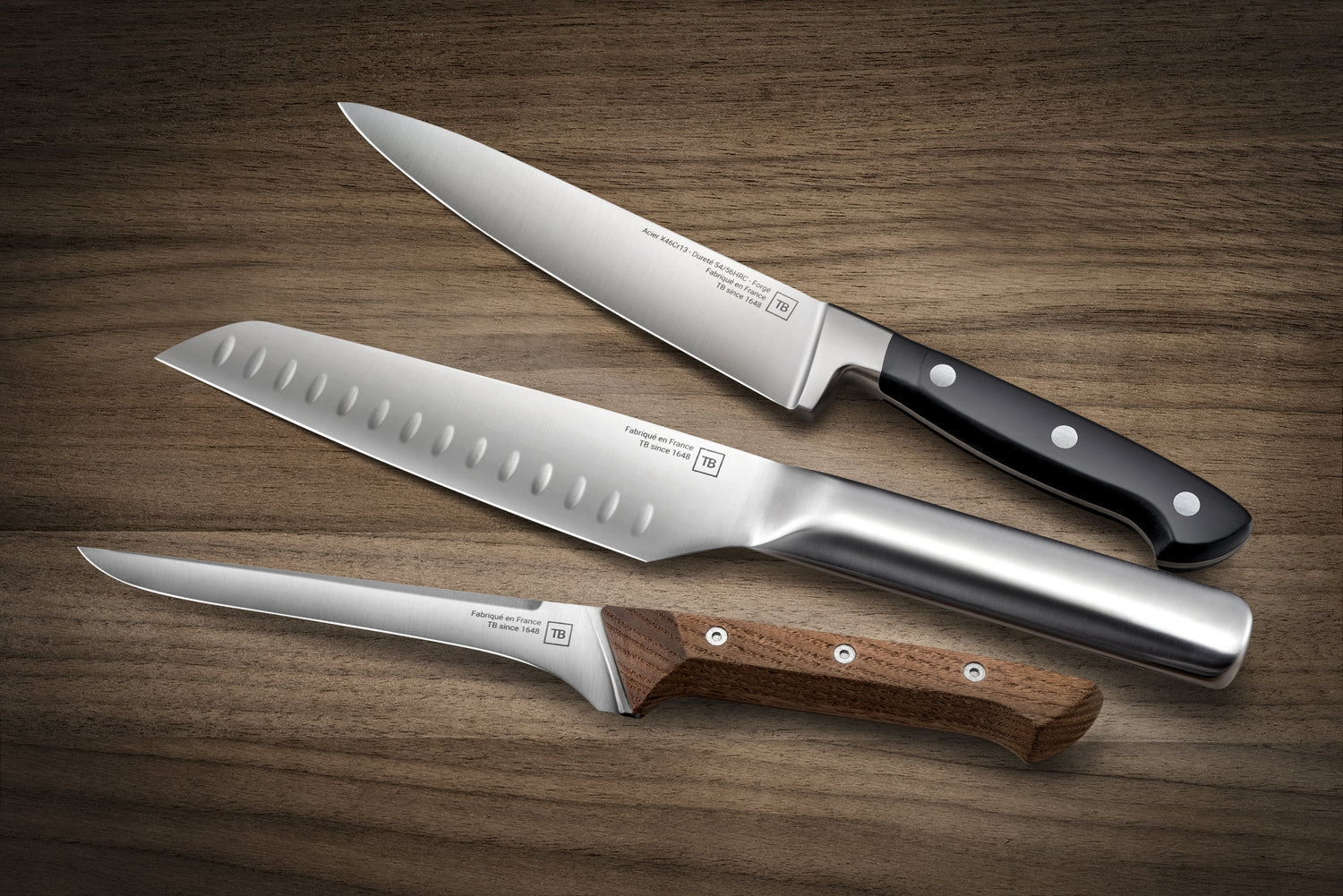
- Maestro Idéal Forgé: This range embodies the alliance of tradition and modernity. The knives are entirely forged in France from Nitrox 16Cr stainless steel. They feature a full tang, a distinctive round bolster, and an ergonomic POM handle.
Non-Forged Full-Tang Quality: TB Groupe's Signature Innovation
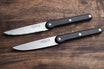
- Louis: Our primary example of non-forged excellence. Full-tang Nitrox steel blade, solid Walnut handle with a beveled profile. A high-quality, light, and refined alternative.
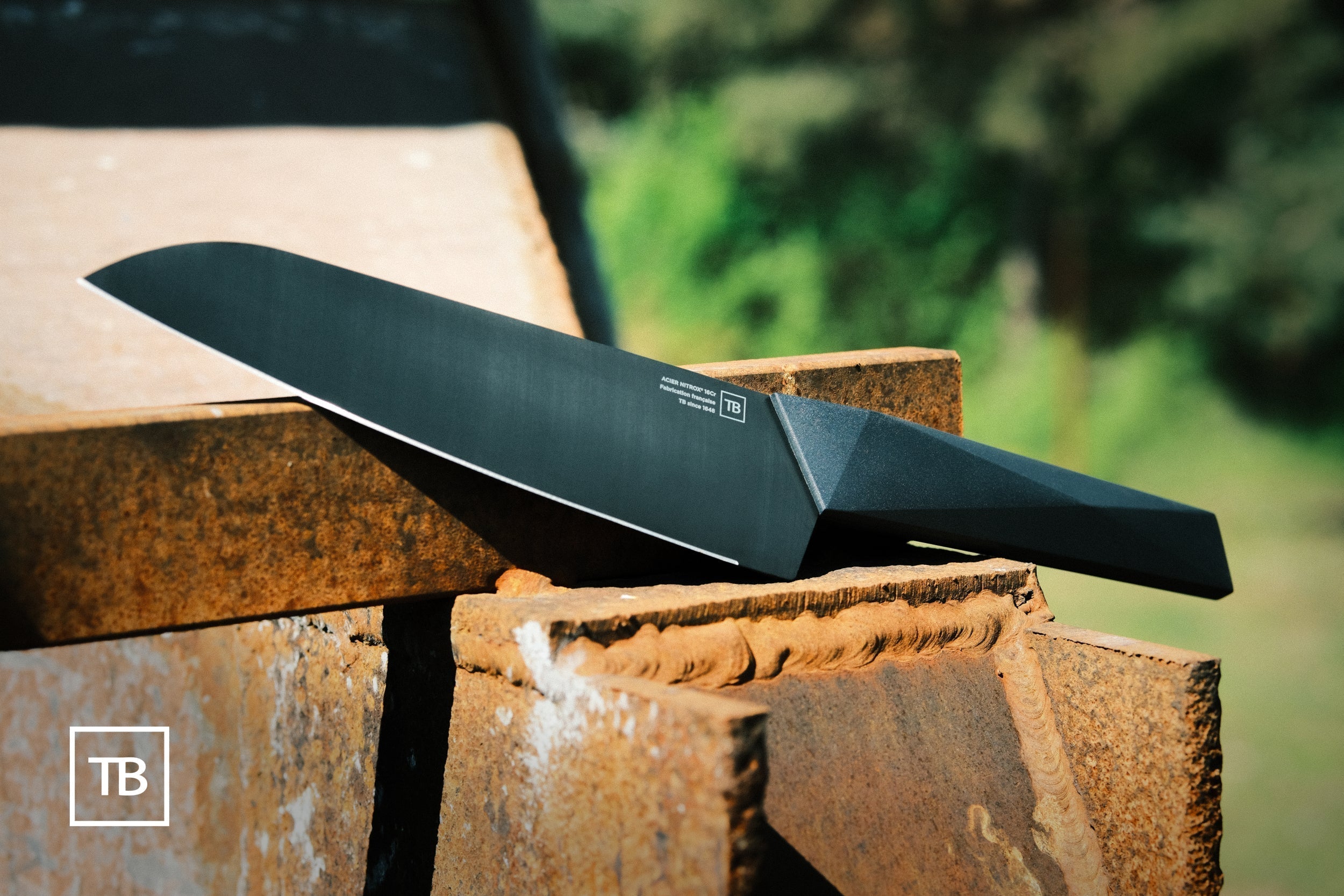
- Other ranges (Furtif, Absolu...): Collections featuring robust tangs and quality materials (Rosewood for Absolu, modern design for Furtif).
These ranges demonstrate that it is possible to achieve an exceptional level of quality with modern methods, without compromising on full-tang construction. Our portfolio includes premium forged lines and non-forged full-tang lines to meet all preferences, while remaining true to "Made in France" quality.
Also note the synergy of materials: noble woods (Olive, Walnut) for classic aesthetics, and synthetic materials (POM, ABS) for practicality and dishwasher resistance, highlighting the intended use of each TB Groupe line.
Maintaining Your TB Groupe Knives: Simple Gestures, Maximum Durability
Whether you have chosen a forged knife or a non-forged full-tang knife, proper maintenance is key. A well-maintained knife is more pleasant and safer to use.
Cleaning: The Golden Rule
Always wash your knives by hand with a soft sponge and dry them immediately. Never let them soak. Although POM is dishwasher safe, hand washing is still preferable to preserve the blade's shine.
Storage: Protecting the Edge
Avoid clutter in drawers. Opt for a knife block, a magnetic strip, or individual sheaths to protect the edge and ensure your safety.
Sharpening and Honing: Maintaining the Edge
- Honing: Regular use of a sharpening steel to straighten the edge. This is routine maintenance to keep the edge sharp daily.
- Sharpening: Done with a whetstone to recreate the edge when the knife is dull. Requires more technique and is done less frequently.
The Cutting Board: Your Blades' Ally
Use quality wood or plastic. Absolutely avoid glass, marble, or ceramic, which instantly destroy blade edges.
Your Kitchen Ally, by TB Groupe
The choice between forged and non-forged full-tang is a matter of personal preference. Forged appeals with its monolithic robustness and tradition, while stamped full-tang offers agility and modernity without sacrificing strength.
Our "Made in France" promise embodies the fusion of our historical expertise, constant innovation, and rigorous quality control (ISO 9001 and 14001). Whatever the blade type, at TB Groupe you will find a reliable partner designed to last. Explore our collections and let the excellence of French cutlery enhance your culinary experience.