

As a manufacturer and cutler since 1648, we design and test the products presented in this guide. While we are proud of our TB creations, our priority is to provide you with objective technical advice to help you choose the right tool for your needs.
In the fascinating world of cutlery, some names resonate with a particular aura. The Santoku knife is one of them. Originating from Japan, it has conquered kitchens worldwide, appealing to Michelin-starred chefs and home cooking enthusiasts alike. But what makes this knife so special? Why has it become an essential tool alongside the traditional chef's knife?
At TB-1648, with our heritage as French cutlers since 1648 and our passion for innovation and "Made in France" quality, we offer you this comprehensive guide to understand everything about the Santoku knife. From its definition to its unique characteristics, its comparison with the chef's knife, and the presentation of our own Santoku creations, join us in exploring the world of this exceptional tool.
The Santoku knife: definition and origins of a versatile blade
The Santoku is much more than just a knife; it is a cutting philosophy straight from Japan. To understand its global success, we must go back to its roots and decipher what makes it so unique.
The meaning of the name: "Three Virtues" for unparalleled versatility
The name "Santoku" (三徳包丁, santoku-bōchō) literally translates to "three virtues" or "three uses". This poetic name refers to its exceptional ability to excel in three fundamental kitchen tasks: slicing, dicing (or mincing), and chopping. Some also interpret these "three virtues" as its ability to work with three types of food: meat, fish, and vegetables. Whatever the interpretation, the message is clear: the Santoku is designed to be an extremely versatile knife, a true everyday ally.
Japanese origins: a response to modern needs
Unlike some traditional Japanese knives with centuries-old traditions, the Santoku is a relatively modern creation, appearing in Japan in the 1940s-1950s, after World War II. At that time, Japan was opening up to Western influences, including culinary ones. Japanese housewives were looking for a lighter, more manageable, and more versatile knife than traditional specialized knives (such as the Deba for fish or the Nakiri for vegetables) to adapt to new eating habits and modern home kitchens.
The Santoku was born from this need, fusing the inspiration of the Western chef's knife (Gyuto in Japanese) with the demands of Japanese cuisine. It quickly gained popularity in Japan, becoming the most common kitchen knife in homes, before conquering the rest of the world.
Distinctive characteristics of the Santoku knife
The Santoku is easily recognizable thanks to several characteristics that give it its unique identity and effectiveness. At TB-1648, we pay particular attention to these details to offer you high-performance and pleasant-to-use Santokus.
The blade shape: shorter, wider, less pointed
- Length: A Santoku blade is generally shorter, measuring between 14 and 20 cm (most often 16-18 cm), compared to 20 to 30 cm for a chef's knife. This reduced size makes it lighter and more manageable.
- Width: The blade is often wider than that of a chef's knife, which allows for easy scooping of cut food from the board to transfer it to a container.
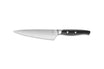
- Profile: The Santoku's edge is straighter than that of a chef's knife, with a less pronounced curve towards the tip. The spine of the blade descends more abruptly towards the tip, creating a shape sometimes called a "sheep's foot." This tip is therefore less aggressive and less pointed than that of a chef's knife.
Dimples (Granton Edge): an anti-adhesion asset
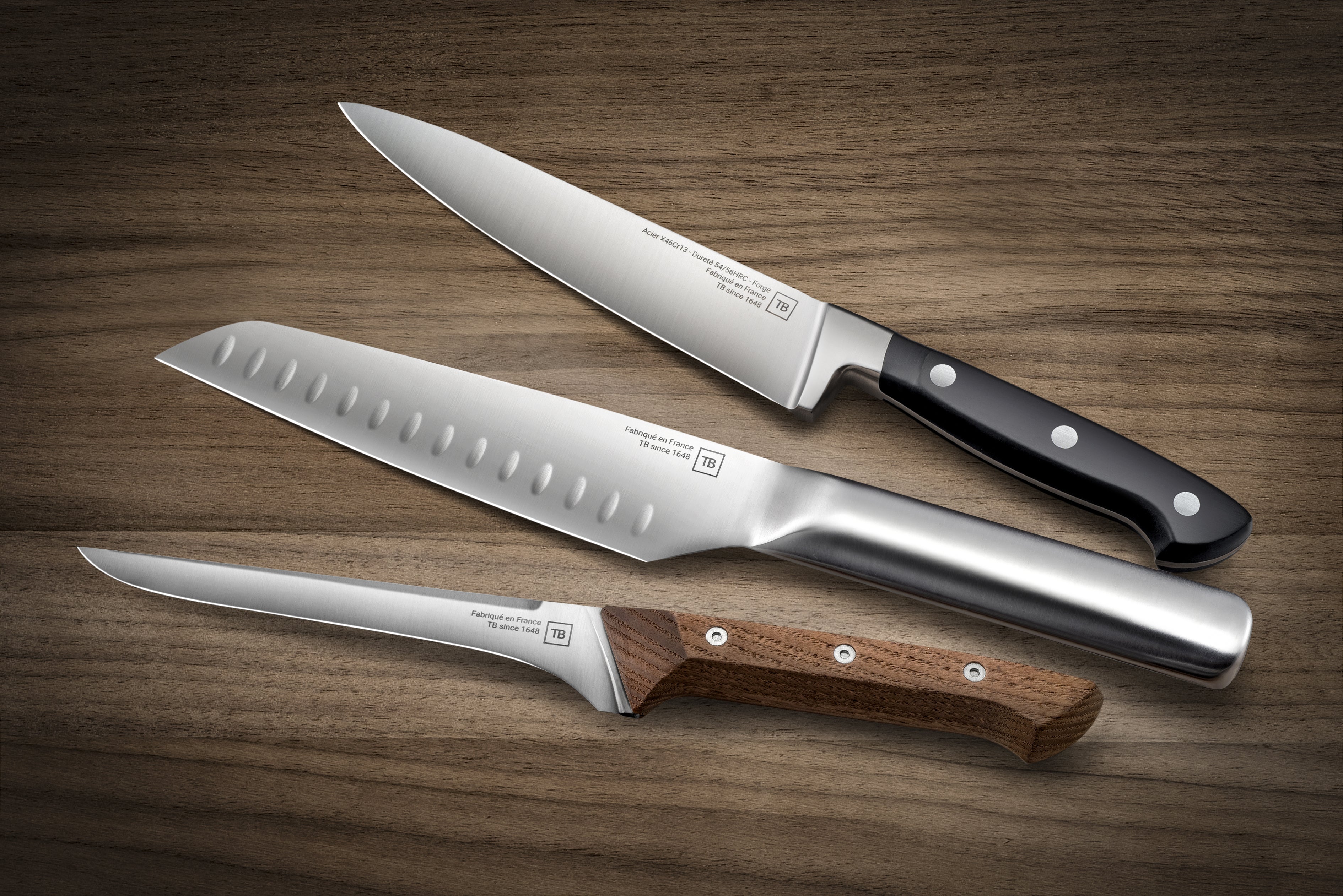
Many Santoku knives, including some models we offer at TB-1648, feature dimples on the sides of the blade. These small oval depressions create tiny air pockets between the blade and the food during cutting. This ingenious trick reduces friction and prevents food, especially wet or sticky items like potatoes, cucumbers, raw salmon, or soft cheese, from sticking to the blade. The result? Cleaner slices, smoother cutting, and fewer interruptions to detach food.
Steel and handle: balance and ergonomics
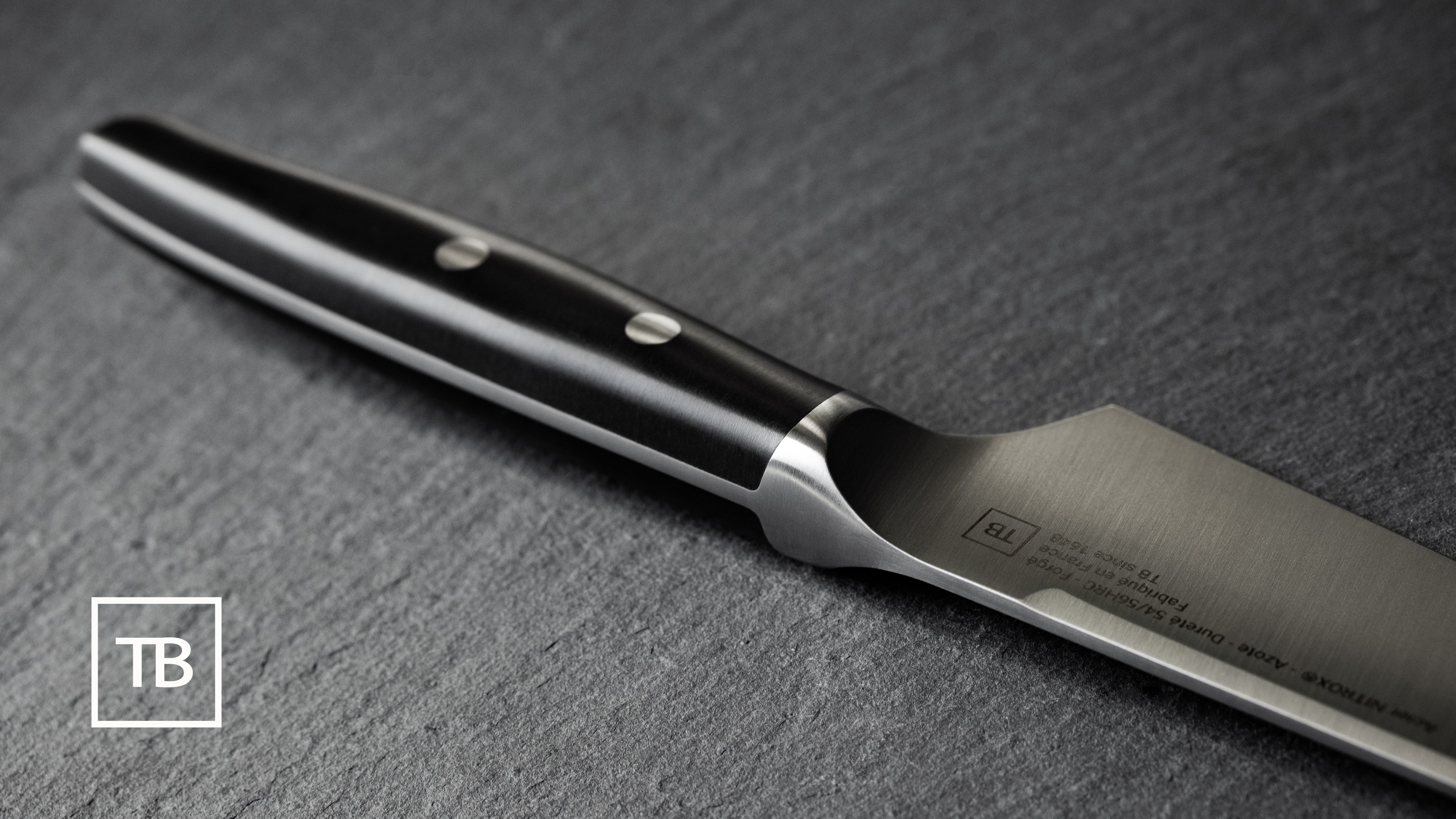
- Blade steel: Santokus can be made from different types of steel. Stainless steels are common for their ease of maintenance. Carbon steels are prized for their exceptional sharpness. At TB-1648, we primarily use high-quality steels, such as Nitrox® steel or specific steels for our Evercut® technology.
- Handle: Ergonomics are essential. Materials vary: wood (Walnut), polymers (POM, ABS), or metal. A good Santoku should be well-balanced between the blade and the handle to reduce fatigue during prolonged use.
Santoku vs. Chef's Knife: the duel of versatility
While both are versatile, they have notable differences that will guide your choice based on your habits.
Cutting techniques: rocking vs. push cut
- Chef's Knife: Curved blade ideal for the rocking motion. The tip remains in contact with the board.
- Santoku Knife: Straighter edge suitable for a vertical or push cut. The blade is lifted after each cut.
Preferred uses: complementarity in the kitchen
- Chef's Knife: Excellent for cutting large pieces of meat and work requiring an ample rocking motion.
- Santoku Knife: Perfect maneuverability for mincing herbs, precisely dicing vegetables, and slicing raw fish.
| Characteristic | Santoku Knife | Chef's Knife |
|---|---|---|
| Origin | Japan (modern) | Europe |
| Meaning | "Three virtues" | Professional use |
| Technique | Vertical / Push | Rocking |
| Dimples | Frequent | Less frequent |
| Advantage | Maneuverability, light | Robustness, heavy |
Discover "Made in France" Santoku knives by TB-1648
Evercut® Range: Exceptional sharpness
For those seeking the ultimate in performance, our Evercut® Origine Santokus feature an Evercut® steel blade with patented laser fusion technology. Choosing an Evercut® Santoku means investing in an almost indestructible tool, guaranteed for life.
Louis Range: The elegance of Walnut and Nitrox®
The Louis range embodies French elegance. The Louis Santoku has an 18 cm Nitrox® steel blade, a full tang construction, and an ergonomic Walnut handle for smooth and refined cutting.
Maestro Range (Top Chef®): The professional's tool
The Maestro Idéal Forged Santoku is a robust forged knife. It features an 18 cm Nitrox® 16Cr steel blade (56 HRC), a full tang forged in France, and a riveted black POM handle.
Georges Range: Tradition and modernity
The Georges range offers forged Santokus. The Georges Wood Santoku offers a full tang blade and a Walnut handle, while the POM version ensures easy maintenance.
Furtif Range: Assertive design
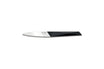
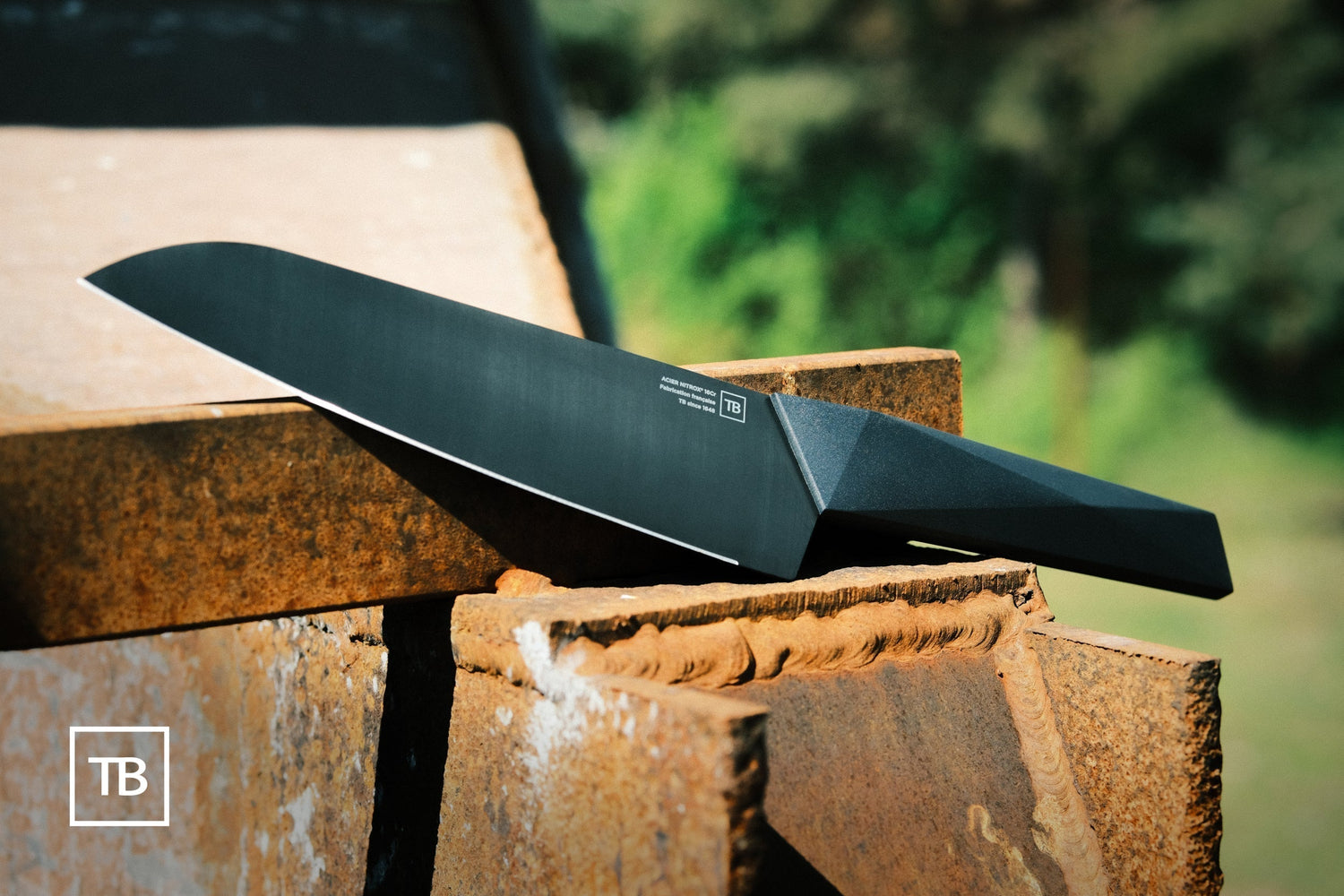
The Furtif Stainless Steel Santoku offers a characteristic geometric design with a POM handle for a distinctive and modern look.
Maintenance tips
- Hand washing: Golden rule. Warm water and mild soap. Avoid the dishwasher (heat and aggressive detergents).
- Immediate drying: Wipe thoroughly with a dry cloth to prevent water stains.
- Storage: Use a knife block or magnetic strip to protect the blade's edge.
- The right cutting board: Prefer wood or plastic. Avoid glass, marble, or ceramic.
The TB-1648 Santoku, a choice of excellence
The Santoku knife has established itself as an indispensable tool. Choosing a TB-1648 Santoku means opting for "Made in France" quality, backed by four centuries of expertise in Thiers. Whether you choose the elegance of the Louis range, the robustness of Maestro or Georges, or the innovation of Evercut®, you will find the Santoku that will enhance your culinary preparations on tb1648.com.