

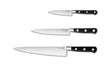
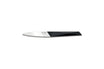

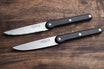

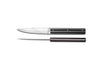
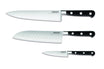


In the arsenal of a gastronomy enthusiast, the distinction between precision tools and versatile instruments is fundamental. At TB-1648, a manufacturer inheriting the expertise of Thiers, we often observe confusion between the paring knife and the utility knife. Although their silhouettes resemble each other, their technical souls differ radically. The former is the kitchen's goldsmith, intended for precise movements and delicate peeling, while the latter aims to be the indispensable bridge between small tasks and the power of the chef's knife. Choosing between these two pillars of French cutlery is not a matter of chance, but of a careful analysis of your preparation habits. This technical guide details the characteristics of the steel [MISSING TECHNICAL INFO] and the blade geometries that forge the identity of our collections, to help you sculpt your own kitchen set with professional rigor.
What are the real differences in size and weight?
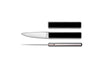
Size is not just a linear measurement at TB-1648; it defines the tool's balance point. The paring knife features a short blade, generally between 7 and 11 cm. This compactness allows the handle to rest in the palm of the hand, offering absolute control of the tip. It is the natural extension of the thumb. Its light weight reduces fatigue during repetitive tasks such as denerving or peeling baskets of vegetables.
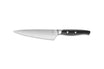
In contrast, the utility knife offers a blade ranging from 12 to 15 cm. Longer, it also has a slightly taller blade, which provides space for the knuckles if you are working on a board. The weight is more pronounced, providing welcome inertia when cutting denser fruits or small poultry pieces. The tang of these models is designed to offer increased stability, typical of the robust production of Thiers.
| Criterion | Paring Knife | Utility Knife |
|---|---|---|
| Blade length | 7 to 11 cm | 12 to 15 cm |
| Spine thickness | Thin (Precision) | Medium (Versatility) |
| Mounting type | Full tang | Forged full tang |
What are the major differences in culinary use?
Usage defines the form. The TB-1648 paring knife is designed for "in-air" work. Whether you're turning an artichoke, hulling strawberries, or mincing a clove of garlic, the movement is circular and internal to the hand. Its fine tip is a scalpel capable of incising with controlled depth. It is essential for all the aesthetic finishes that transform an ordinary dish into a gastronomic creation.
The utility knife, on the other hand, is the quintessential "housewife's knife," reinterpreted by our industrial expertise. It excels where the paring knife is too short and the chef's knife too cumbersome. Cutting a sandwich, slicing sausage, dicing cherry tomatoes, or preparing a small pork roast becomes routine. Its length allows it to cut through medium-sized foods in a single pass, ensuring a clean cut without tearing the fibers.
List of ideal tasks for the paring knife:
- Peeling fruits and vegetables with thin skins.
- Precisely pitting and seeding.
- Carving vegetable decorations.
- Removing potato eyes.
- Finely mincing shallots.
List of ideal tasks for the utility knife:
- Slicing citrus fruits (lemons, oranges).
- Cutting semi-hard cheeses.
- Slicing chicken fillets into strips.
- Slicing small bread rolls or baguettes.
- Preparing sandwich fillings.
What are the advantages and disadvantages of each model?
The main advantage of the paring knife is its absolute precision. Its major disadvantage lies in its specialization: as soon as the food exceeds 10 cm in diameter, the cut becomes choppy and irregular. Conversely, the utility knife offers reassuring versatility for the busy cook. However, it lacks the finesse for carving tasks, and its weight can become a hindrance for prolonged peeling of small vegetables.
At TB-1648, we forge our blades from [MISSING TECHNICAL INFO] steel to overcome these weaknesses. The Rockwell hardness [MISSING TECHNICAL INFO] ensures that even the utility knife maintains a sharp edge for delicate tasks, while the ergonomic design of our paring knife handles allows for a secure grip despite the tool's small size.
| Food | Paring Knife Performance | Utility Knife Performance |
|---|---|---|
| Garlic / Shallot | Excellent | Correct |
| Tomato / Citrus | Average | Excellent |
| White meat | Unsuitable | Excellent |
| Herbs | Good (Mincing) | Average |
Which one to choose depending on your cooking profile?
If you are a "Meal Prep" enthusiast and handle large volumes of vegetables, the TB-1648 paring knife is your best ally. It will become an extension of your hand for all initial preparation steps. Creative profiles, who enjoy plating and meticulous presentations, will not be able to do without its tapered tip.
On the other hand, if you often cook "on the fly," prepare many quick lunches or appetizer platters, the utility knife will be essential. It is the tool of fluidity that avoids changing knives every two minutes. For students or those with a small kitchen, it is often the rational first choice before investing in a complete range.
Maintenance tips for your future TB-1648 blade:
- Use a honing steel to maintain the edge before each session.
- Clean your blade immediately after use, especially after cutting acidic foods.
- Avoid glass cutting boards, which prematurely dull the steel.
- Apply a drop of neutral oil to the handle if it is made of precious wood.
Essential safety precautions:
- Never try to catch a falling knife.
- Always carry the knife point down along your leg.
- Keep fingers curled (the "claw" technique) when cutting on a board.
- Do not store bare blades in a drawer; prefer a block or magnetic strip.
How does Thiers' expertise enhance these two tools?
The strength of TB-1648 lies in the balance between heritage and innovation. Each knife, whether paring or utility, undergoes rigorous heat treatment. This process ensures that the blade has the necessary flexibility not to break, while maintaining sufficient hardness for a durable edge. The solid bolster of our utility models ensures a smooth transition between the blade and the handle, offering a comfortable support area for the index finger, essential for guiding the cut with authority.
Conclusion: Harmony rather than compromise
Ultimately, the duel between the paring knife and the utility knife has no single winner. These two tools are two sides of the same coin: that of a mastered kitchen. The paring knife is the master of shadow, the one who prepares and enhances, while the utility knife is the everyday partner, efficient and unadorned. At TB-1648, we often advise starting with a paring knife for its incomparable precision, then complementing your set with a utility knife for the freedom it provides. By choosing a blade forged in Thiers, you are not just buying an utensil; you are adopting a fragment of French cutlery history designed to last and to transform every culinary gesture into a moment of pure technical pleasure.