

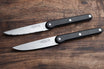
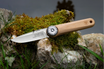
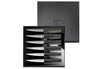
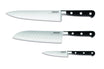

A high-end knife is also judged by how it is stored. A freshly sharpened edge quickly dulls if it rubs against other utensils in a jumbled drawer. Wooden block, magnetic strip, or organized drawer: each solution has its advantages, and the choice depends as much on the available space as on the number of knives to store.
Key points of the article
- Loose storage in a drawer is the most damaging solution for the cutting edge and the riskiest for safety.
- The wooden block provides effective protection but occupies a fixed space on the countertop.
- The magnetic strip optimizes space and facilitates access, provided it is securely fixed.
Why avoid loose storage?
Storing unprotected knives in a drawer, mixed with other utensils, exposes them to repeated friction that dulls the cutting edge. This storage method also carries a risk of cuts when blindly searching for a utensil. It is the least suitable solution, regardless of the quality of the knife in question.
The wooden block
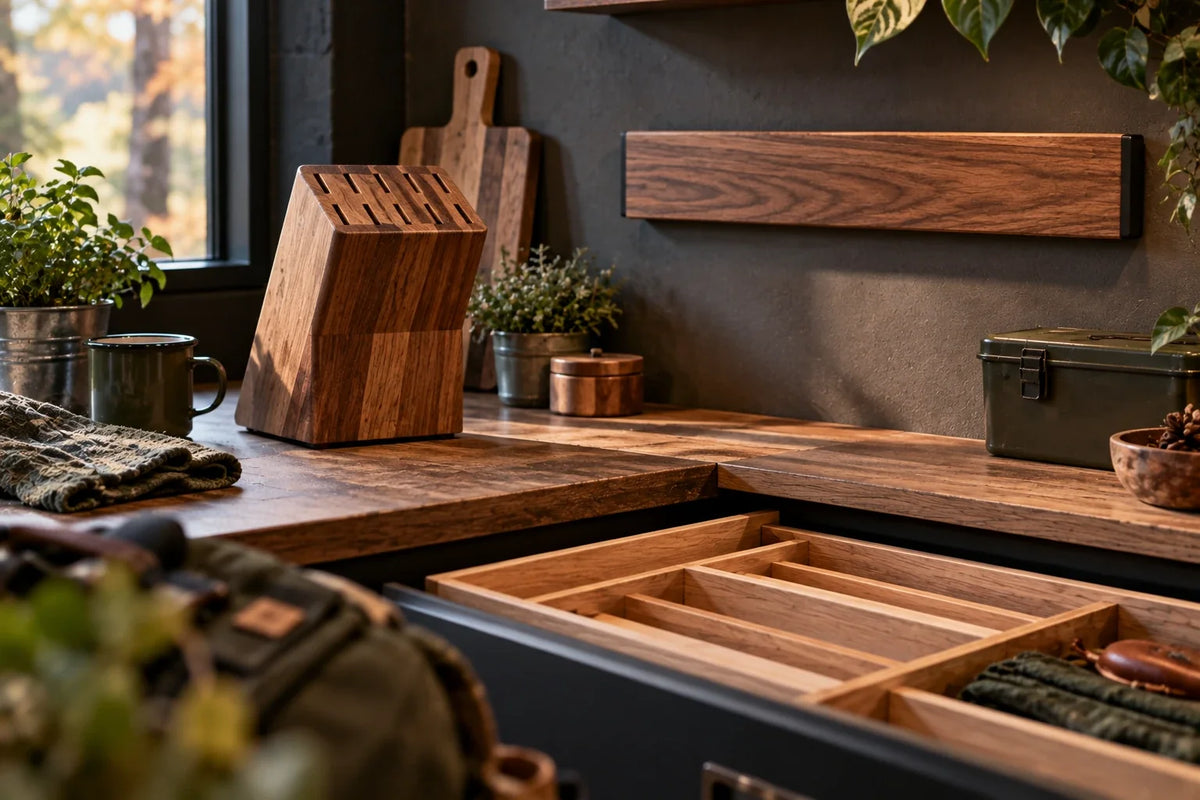
The wooden block remains the most common solution. Each blade is isolated in its own slot, which protects both the cutting edge and your fingers when handling it. Its main disadvantage is the fixed space it occupies on the countertop, as well as a limited number of slots to the number of provided openings.
The magnetic strip
Fixed to the wall, the magnetic strip frees up countertop space and allows you to see all your knives at a glance. It easily adapts to a growing number of pieces, unlike a block with fixed slots. The point of vigilance concerns the wall mounting, which must be solid, and the gesture of placing and removing, which must be done carefully to avoid any blade slippage.
The organized drawer with protection
A drawer equipped with a holder or individual sheaths combines the advantages of the block (edge protection, safety) with space saving on the countertop. This solution requires a dedicated drawer, but is well suited for kitchens where wall space or countertop space is limited.
Comparison of storage solutions
| Solution | Edge Protection | Space Requirement | Safety | Capacity |
|---|---|---|---|---|
| Wooden block | High | Countertop | High | Limited to slots |
| Magnetic strip | High | None (wall-mounted) | Good if well fixed | Scalable |
| Organized drawer | High | None (integrated) | High | According to drawer dimensions |
| Loose in a drawer | Low | None | Low | Unlimited but not recommended |
Which solution to choose depending on your kitchen?
A kitchen with limited countertop space will benefit from opting for a magnetic strip or an organized drawer. A kitchen with available space can keep a wooden block, which is aesthetic and functional. In all cases, the essential thing is to isolate each blade from other utensils, regardless of the chosen solution.
Find our kitchen and storage accessories in the Accessories collection.
Frequently asked questions
Can a magnetic strip damage a Damascus blade?
No, magnetism does not alter the structure or pattern of the blade. The point of attention is solely on the placement gesture to avoid any shock against the support.
Should a wooden block be disinfected regularly?
Regular maintenance is recommended, especially cleaning the slots, to prevent the accumulation of moisture and residues.
Does storage influence the necessary sharpening frequency?
Yes. A knife protected between each use retains its cutting edge longer than a knife that rubs against other utensils, which reduces the need for sharpening.
Glossary
Sheath: Individual case designed to protect a blade during storage or transport.
Magnetic strip: Wall-mounted holder equipped with magnets for attaching knives by their blades.