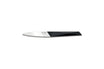
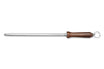

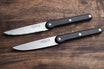
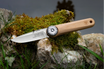
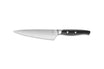
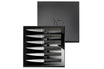
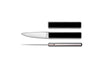
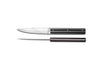
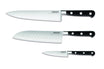

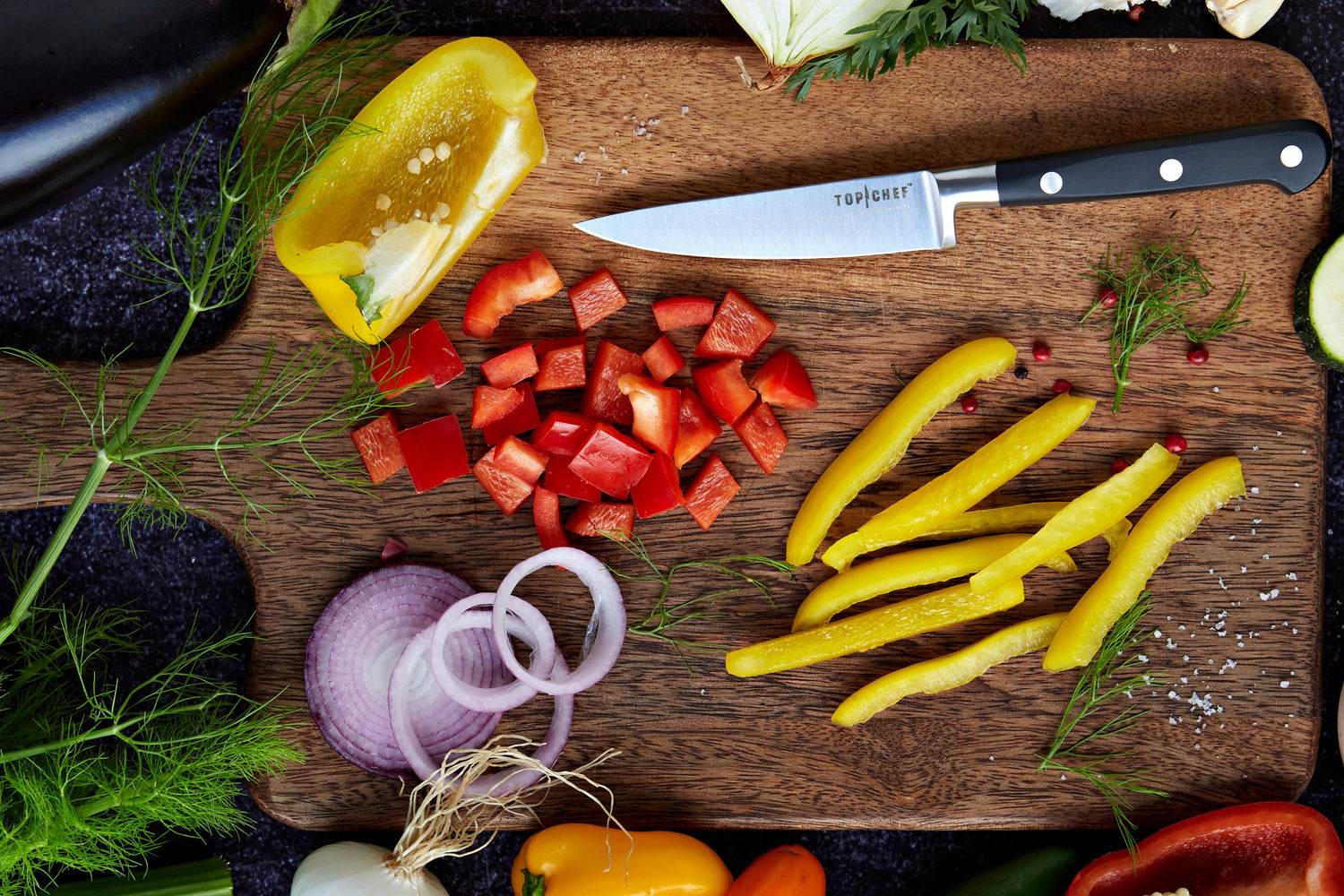
You have chosen excellence by treating yourself to TB-1648 kitchen knives. That is the first step, and the most important one. But for the magic of cutting to work day after day, you need to think about the environment your blades work in. An exceptional knife is a high-precision tool whose cutting edge is only a few microns thick.
This zone, so effective, is also incredibly fragile. The two biggest dangers it faces are not necessarily the ones you might think: your cutting board and your kitchen drawer. Here is how to turn these potential risks into your best allies.
The essentials for never damaging your blades
- The right cutting surface: Use only wooden or plastic boards. These are the only materials that respect your knife's edge.
- The right storage: Always keep your knives separate. A block, a magnetic strip or individual sheaths are essential to avoid damaging knocks.
Which cutting board should you choose to avoid damaging your blades?
This is a fundamental question. The surface you cut on has a direct and immediate impact on how long your knife's edge lasts. The wrong choice can ruin the edge of a perfectly sharpened blade in just a few strokes.
Materials that are kind to your knives
There is no secret: you need a material that is "softer" than the steel of the blade. That way, the edge penetrates the material without wearing prematurely. Two families of materials are recommended:
- ✅ Wood: Beech, bamboo, walnut... This is the traditional and excellent choice. Wood is soft, hygienic (with proper care) and preserves the edge perfectly.
- ✅ Plastic: Quality polyethylene boards are a very good alternative, easy to clean and not at all harsh on the edge.
Materials to ban from your kitchen
We know a beautiful slate or glass board can seem "pretty" or "organic." But for your knives, it is a real nightmare. These materials are harder than steel, and every cut causes a micro-impact that destroys the edge. Using them is utterly destructive to cutting performance.
- ❌ Glass
- ❌ Ceramic
- ❌ Slate
- ❌ The marble or granite of your countertop
How should you store your knives to protect such a fragile edge?
Your knife has done its job; it is time to put it away. The most common mistake? Slipping it into the cutlery drawer, among the forks and spoons. This is, without exaggeration, the best way to damage the product. Every time the drawer is opened and closed, your blade takes knocks that end up destroying that famous 3-to-5-micron edge.
To keep the edge protected, there is just one rule: blades must never touch each other or knock against other metal objects.
- The knife block
- An iconic, safe solution, the block offers a dedicated slot for each knife, ensuring it is perfectly separated from its "colleagues."
- The wall-mounted magnetic strip
- Practical and stylish, it keeps your tools within reach while isolating them from one another. Each knife has its own space.
- The protective sheath
- This individual case changes everything. Once protected in its sheath, your knife can be stored in a drawer without any risk.
Your questions, our answers
My wooden board is covered in knife marks. Is that normal?
Yes, and it is actually a good sign! These marks prove that your board is doing its job: it is soft enough for the blade to sink in slightly, thus preserving its edge. A board with no marks at all is probably too hard for your knives.
Can magnetic strips make knives fall?
If you choose a good-quality strip with strong magnets, the risk is practically zero. Make sure to press the flat metal part of the blade firmly against the strip. It is a very safe solution used by many professionals.
I used a glass board and my knife no longer cuts. Is it irreversible?
No, fortunately! The edge is "simply" dull, meaning it has become rounded. It is not broken. Good honing with a honing steel, a manual sharpener or by a professional will reform that sharp edge and restore your knife's full effectiveness.