

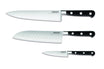


Choosing a high-end knife requires understanding precise technical vocabulary. Tang, bolster, ricasso, full tang: these terms describe elements that directly determine a knife's strength, balance, and durability. This glossary brings together the essential definitions to read a product description with full understanding.
Key points of the article
- Cutlery vocabulary describes precise construction elements, not just commercial names.
- Understanding these terms allows for objective comparison between two knives.
- Certain terms, such as HRC or Damascus steel, systematically appear in technical specifications and deserve a clear definition.
What are the terms related to the blade?
Blade
The sharp part of the knife, obtained by cutting, forging, and heat-treating steel.
Ricasso
The unsharpened portion of the blade, located just in front of the handle or bolster. It serves as a resting area for the index finger when using a pinch grip.
Heel
The base of the blade, opposite the tip, generally the thickest and strongest part.
Grind
The cross-sectional shape of the blade. It determines how the blade penetrates material and releases from the cut.
Damascus Steel
Steel obtained by forging several layers of different metals, hammered and folded together. The visible pattern on the blade results from this layered structure, revealed by polishing or light chemical etching.
HRC
Abbreviation for the Rockwell C hardness scale, which measures a steel's resistance to penetration. For a high-end kitchen knife, common values are between 55 and 62 HRC. Details of hardness ranges are explained in our article What HRC hardness to choose for a knife?.
What are the terms related to the handle?
Tang
The extension of the blade inside the handle. Its length and shape directly affect the strength of the assembly.
Full Tang
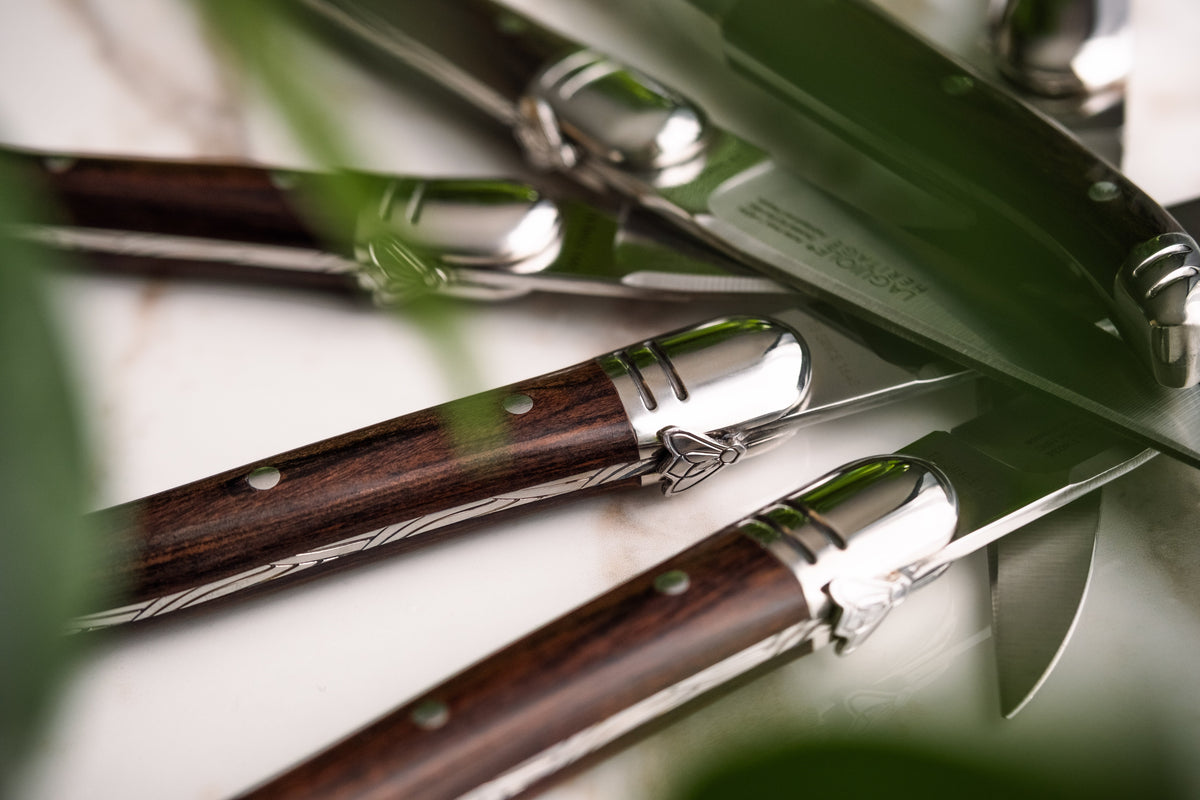
Construction in which the tang extends the entire length of the handle and remains visible on top, typically secured by rivets. This type of mounting is sought after for its robustness.
Bolster
A metallic piece placed between the blade and the handle. It protects the joint, reinforces the knife's balance, and, on high-end models, contributes to the overall aesthetic.
Rivets
Fastening elements passing through the handle and the tang to ensure durable retention, visible on full tang constructions.
Summary table
| Term | Area concerned | What it determines |
|---|---|---|
| Ricasso | Blade | Finger rest, pinch grip |
| Grind | Blade | Cutting performance |
| HRC | Blade | Hardness, edge retention |
| Tang | Handle | Assembly strength |
| Full Tang | Handle | Robustness and balance |
| Bolster | Blade/handle junction | Protection and finish |
Why is this vocabulary useful when purchasing?
A product description that mentions a full tang construction, a stainless steel bolster, or a hardness of 58 HRC communicates verifiable information about the knife's construction. This vocabulary allows for objective comparison between two models, beyond their aesthetic appearance. For reference content on handle materials, see our comparison Damascus steel on Wikipedia for the complete metallurgical definition.
Frequently Asked Questions
Is a full tang always a guarantee of superior quality?
It is a guarantee of robustness for the blade/handle joint, but other constructions can offer an excellent level of quality depending on the intended use of the knife.
Does the bolster have only an aesthetic role?
No. It protects the blade/handle joint from moisture and shocks, in addition to contributing to the overall balance of the knife.
Does the pattern of a Damascus blade impact its cutting performance?
The pattern is the visible consequence of the steel's layered structure. Cutting performance primarily depends on the final hardness and sharpening, not the pattern itself.
Additional glossary
Quenching: A heat treatment that hardens steel by heating and then rapid cooling.
Edge: The sharp cutting edge of the knife, whose geometry depends on the grind and sharpening.
Pakkawood: Laminated wood compressed with resin, used for handles due to its moisture resistance.