


Damascus is one of the most frequently used — and most misunderstood — terms in cutlery. It evokes the medieval blacksmith, the legendary blade that cuts through marble, the transmission of ancestral knowledge. The metallurgical reality is both more precise and more interesting than the myth.
Historic Damascus is not modern Damascus
Original Damascus steel — known as Wootz — was a very high-carbon steel, developed in the Indian subcontinent and traded across the Middle East. Its unique microstructure, linked to its chemical composition and slow cooling cycles, generated surface patterns and exceptional mechanical properties. The exact formula was lost between the 17th and 19th centuries. It has not yet been industrially reproduced in a controlled manner.
What cutlers call "Damascus" today is technically pattern welding: a forging process involving the fire welding of different steel sheets, repeatedly folded and stretched. The result is structurally distinct from Wootz but constitutes a metallurgical work in its own right, with its own qualities. Confusing the two is like comparing an ancient bronze with a modern alloy bearing the same name due to visual analogy.
How layered Damascus is formed
The process starts with two steels with complementary properties — for example, a high-hardness steel (type 1095) and a softer, torsion-resistant steel (type 15N20, enriched with nickel for contrast). The bars are heated, forge welded, then stretched and folded back on themselves. With each fold, the number of layers doubles: 2, 4, 8, 16, 32, 64, 128, 256, 512...
Beyond 500 to 600 layers, the effect becomes counterproductive: the layers thin to the point of losing their distinct identity, and the properties of the two steels average out. Most quality Damascus steels have between 64 and 300 layers, depending on the desired effect and the type of product.
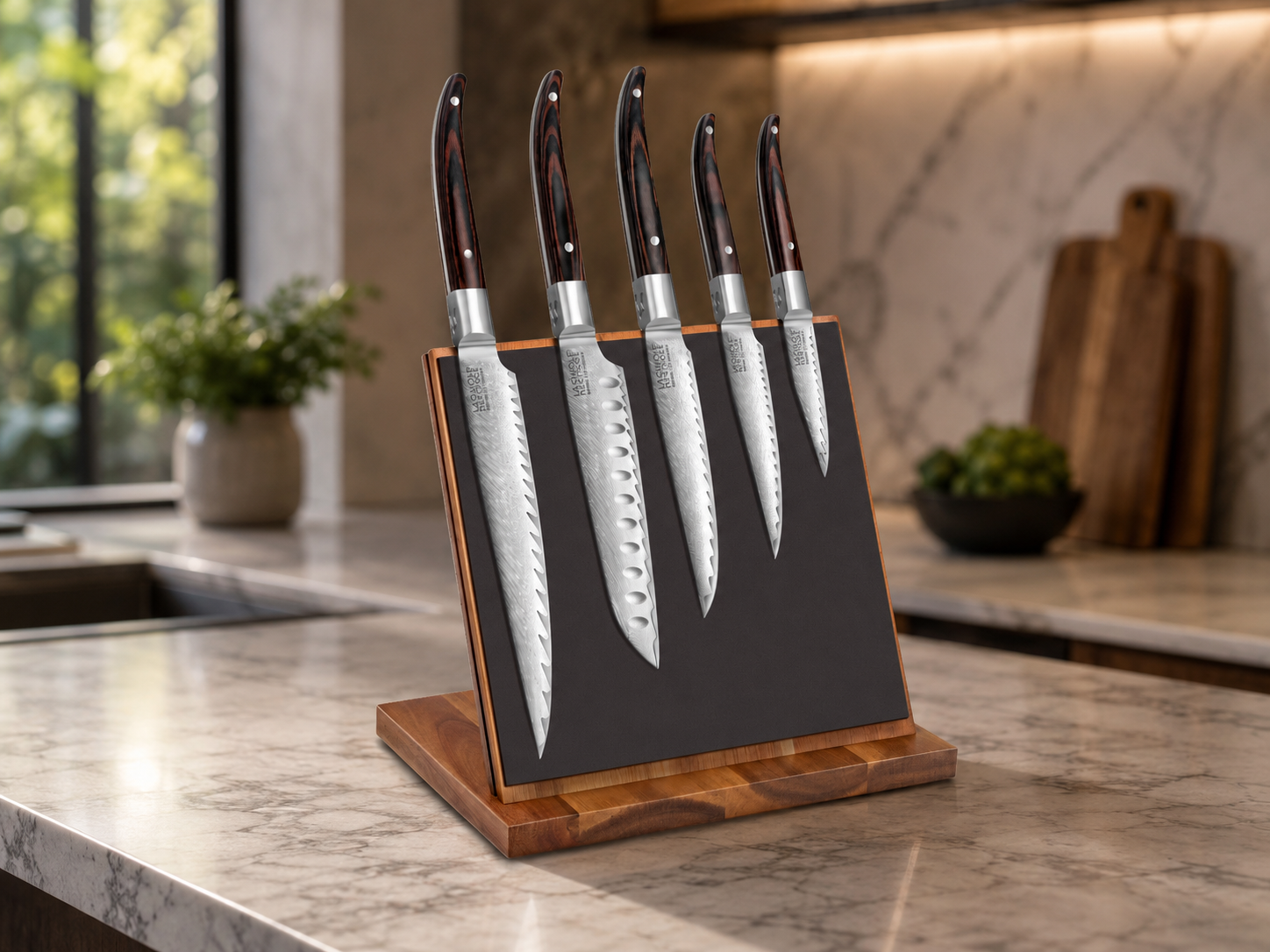
The visible pattern — undulations, waves, "eyes" — results from the geometry of the folding and the chemical etching that reveals areas of different composition. Two blades forged from the same steels and with the same number of layers will have distinct patterns: this is a direct consequence of manual forge work.
What Damascus provides — and what it doesn't
Layered Damascus offers a real performance profile. The alternation of layers of different hardness contributes to resilience: where a hard, homogeneous steel can be brittle on impact, the layering creates discontinuities that slow the propagation of micro-cracks. The blade is tougher. This is a measurable, documented property.
However, Damascus is not a guarantee of absolute edge superiority. The fineness of the edge depends primarily on the hardness of the core steel and the quality of the sharpening, not on the number of layers. A monolithic steel knife, properly heat-treated, can hold an edge superior to a poorly formulated or poorly sharpened Damascus. The pattern is not a performance — it is evidence of a process.
The aesthetic value, however, is undeniable. Each blade is unique. The pattern is intrinsic to the structure, not printed or engraved. For a knife intended to last and be passed down, this singularity has meaning.
The TB-1648 Expression Damascus: A Consistent Positioning Choice
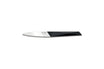
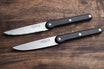
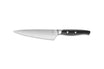
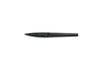
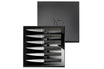
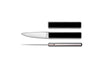
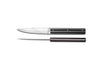
In the Expression Damascus sets offered by TB-1648 — four knives at 265 €, Pakkawood or Olive wood handles — Damascus is presented for what it is: a material with high perceived value, selected and marketed by a company founded in 1648 in Thiers, with the quality requirement that characterizes its cutlery range.
The announced hardness of 52-54 HRC places these blades in a versatile and easy-to-maintain category, accessible to a demanding cook without requiring specific sharpening skills. It's not a promise of a surgeon's blade — it's a promise of a durable, beautiful tool, designed for daily use, with the honesty of not overselling the material's properties.
The myth of Damascus has its place in the history of metallurgy. Modern layered steel has its own, distinct and legitimate place. Understanding the difference allows one to choose knowingly — and appreciate what one holds in one's hands.