

You don't change your tableware every year. Choosing your everyday knives means investing in tools that will be handled twice a day, for years. Yet most households make do with blades that no longer cut or handles that crack.
Drawing on the expertise of TB-1648, a cutler in Thiers for 13 generations, helps you understand what really makes a good knife. Between centuries-old tradition and innovations such as nitrogen-enriched steel, here is everything you need to know to choose the best table knife.
1. The technical criteria of a durable knife
Before talking about design, we need to talk about mechanics. A table knife for everyday use must withstand three enemies: wear of the cutting edge, corrosion, and the thermal shocks of the dishwasher.
The importance of steel: why Nitrox® changes the game
For everyday use, the steel must strike the perfect balance between hardness (to stay sharp longer) and rust resistance.
- Classic steels (1.4034): Used on ranges such as Laguiole Héritage, they offer a hardness of 52/54 HRC. It is a robust standard that delivers efficient cutting.
- Nitrox® steel (the premium choice): TB-1648 uses this "nitrogen-enriched" steel (16% chromium). Nitrogen replaces part of the carbon, which makes it possible to obtain a very hard blade (long-lasting cutting) that is also extremely corrosion-resistant. It is the steel used for French Army knives (such as the CAC®), a guarantee of absolute reliability for your kitchen.
Construction: full tang or nothing?
For intensive use, choose a "full tang" construction. This means that the steel of the blade runs through the handle from end to end.
Advantage: If you apply force to a piece of meat or a hard food, it is the steel structure that absorbs the effort, not the plastic or wood. It guarantees that the knife will never snap in two at the junction between handle and blade.
2. Detailed comparison of the best ranges for everyday use
1. The Ultimate Gastronomic Experience: Ulu & Savik (Guy Savoy Collection)
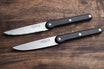
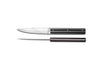
If you want to bring fine dining to your table, this duo is a must. These knives were born from a high-level meeting between three-Michelin-star chef Guy Savoy, his regular designer Bruno Moretti, and TB's industrial expertise.
The story: They were created specifically for Guy Savoy's restaurant at the Hôtel de la Monnaie in Paris, with the ambition of reflecting an "extraordinary" culinary experience.
Technical specs:
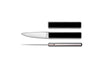
- Exceptional materials: The blade is made of Alenox steel, renowned for its very high quality and corrosion resistance. The handle is made of very fine braided carbon fiber (automotive grade), giving it a technical and precious look.
- Practical innovation: The handle is flat, which allows the knife to rest on its side. It is aesthetic, but above all hygienic: the cutting edge never touches the tablecloth, preventing stains.
The killer detail: There are two versions, the "Savik" (often considered the men's model, with a thicker handle) and the "Ulu" (the women's model, slimmer), allowing a personalized table setting.
2. "Wood & Technicality" Innovation: The Louis Model
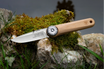
The Louis model is a recent "little gem" (created around 2019-2020) that reconciles a love of wood with cutting-edge technology.
The concept: It is a wooden knife, but without rivets. A patented technical feat allows the blade to clip into the handle, giving the impression that it "floats" inside.
The materials:
- Handle: Genuine walnut. The fit between the wood (a living material) and the metal is extremely precise, achieved with partners who make musical instruments.
- Blade: It uses Nitrox® steel (16% chromium), the same as that used for French Army knives. It features a "counter-bevel" on the spine and a brushed finish that gives it a very masculine "carved from the solid" look.
Why we love it: For the radius on the tang that catches the light and offers optimal comfort in the hand. It is the knife that "tells a story" once placed on the table.
3. Radical Design: The Furtif
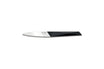
For a resolutely contemporary table, the Furtif is the bold choice. Inspired by the lines of the F-117 stealth bomber, it is a best-seller that has been sold for more than ten years.
The design: It is characterized by geometric, angular lines. Despite this strict appearance, the inclined facet of the handle offers surprising and very comfortable ergonomics.
The technology:
- Black blade: The blade has a PVD (Physical Vapor Deposition) coating. Originating in the military field, this treatment makes the blade black, non-reflective, and extremely resistant to scratches and wear.
- Materials: Faceted ABS handle and high-performance stainless steel blade (often Nitrox depending on the series), with a perfect, seamless metal/plastic junction.
4. Robust Tradition: The Georges Model
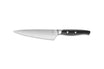
To complete this selection, the Georges model (named in tribute to the grandfather of the Tarrerias family) represents the excellence of the traditional forged knife, the purists' "all-terrain" knife.
Manufacturing: It is a forged knife. The bolster (the metal part between the handle and the blade) is formed by striking hot metal, guaranteeing rock-solid strength.
Easy care: If you opt for the version with a POM (polyacetal) handle, you get the soft, polished feel of a fine knife, but with total resistance to water and the dishwasher. It is the forged knife you can use every day without constraints.
Cutting: Hardened to 54-56 HRC, it offers a long-lasting edge that is easy to resharpen. It is the sensible choice for longevity.
3. The great debate: smooth or micro-serrated blade?
The micro-serrated blade: efficiency without maintenance
It is the "zero hassle" choice par excellence. The micro-serration acts like a micro-saw that bites into the toughest materials.
- Strengths: It requires no sharpening over the long term. The serration protects the cutting edge from direct contact with the plate. It is formidable on foods with a crust (bread) or tough skin (tomatoes, dry sausages).
- The downside: It tends to "tear" the fibers of red meat instead of slicing them cleanly, which can affect the juiciness of a fine cut of beef.
The smooth blade: the prestige of a "surgical" cut
It is the choice of purists and food lovers. A smooth blade glides fluidly into food.
- Strengths: It respects the structure of the flesh, preserves the juices, and offers the most pleasant and noble cutting sensation. It is the standard of the French art of the table.
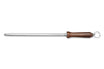
- The downside: It is more sensitive to abrasion. In contact with porcelain or stoneware, the edge dulls. Regular maintenance with a honing steel is necessary to maintain its performance.
The TB-1648 expert's verdict: Peace-of-mind option: If you are looking for a versatile, tireless knife, opt for micro-serration (like our iconic Laguiole Héritage ranges). Gourmet option: If you value precision and respect for the product, a smooth blade (like the Georges or Maestro models) is essential.
4. Care guide: why do your knives rust in the dishwasher?
Even high-quality stainless steel can rust in the dishwasher. This is not a defect of the knife, but a scientific phenomenon called the "battery effect" or galvanic corrosion.
What really happens in your machine:
When your knife blade touches another metal (an 18/10 stainless steel fork, the dishwasher basket) in a hot, humid, acidic (food residue) and basic (detergent) environment, an electric current is created. This current strips particles from the less noble steel, creating rust spots.
The 3 golden rules to keep your knives for life:
- Separate the cutlery: In the dishwasher, never put knives loose in the basket. Place them in the upper cutlery drawer or separate them so that the blades do not touch.
- Ban glass and slate: Never use cutting boards made of glass, ceramic or slate. These materials are harder than steel and instantly crush the cutting edge. Choose wood or plastic.
- Nourish the wood: If you fall for a wooden handle (walnut, olive wood), the dishwasher is off-limits. If the wood becomes dull, rub it with a paper towel soaked in olive oil until saturated to restore its shine.
Conclusion
The best table knife is the one that survives your lifestyle.
- For a hassle-free family: the Victor (micro-serrated).
- For an elegant, modern table: the Laguiole Héritage or the Furtif.
- For food lovers: the Georges POM or the Maestro (smooth blade), forged in Thiers to last forever.
In any case, check the origin: a knife made in Thiers by houses such as TB-1648 guarantees standardized steel and expertise that justify the investment.