

A high-end knife is distinguished by the quality of its steel and the precision of its cutting edge. If poorly sharpened, it quickly loses this advantage, or even gets permanently damaged. Whetstone, honing steel, electric sharpener: each method meets a different need, and not all are suitable for all types of blades.
Key article points
- A honing steel does not replace sharpening: it realigns the edge between two complete sharpenings.
- The whetstone is the most precise method, suitable for hard steels and Damascus blades.
- The electric sharpener is fast but removes more material with each pass.
What is the difference between sharpening and honing?
Sharpening involves removing material to recreate a clean cutting edge. Honing, in the sense of using a honing steel, involves realigning an existing edge that has slightly folded over due to use, without removing material. Confusing the two often leads to over-using the honing steel, thinking one is sharpening the blade, whereas true sharpening is still necessary at regular intervals.
The whetstone
The whetstone is the most precise and steel-friendly method. It allows you to control the sharpening angle, generally between 15 and 20 degrees depending on the blade, and to remove just enough material to recreate a clean edge. This is the recommended method for hard steels (58 HRC and above) and for Damascus blades, whose pattern deserves a controlled touch rather than aggressive mechanical action.
Its disadvantage: it requires learning the technique and preparation time (soaking the stone, maintaining a constant angle).
The honing steel
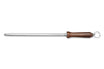
The honing steel, whether steel or ceramic, realigns the cutting edge between two sharpenings. A quick pass before each intensive use extends the time between two complete sharpenings. It never replaces sharpening with a whetstone but reduces the necessary frequency.
The electric sharpener
The electric sharpener offers speed and simplicity of action, at the cost of less control over the amount of material removed. On a high-end knife, too frequent use wears the blade faster than controlled manual sharpening. However, it is practical for occasional use on entry or mid-range knives.
Comparison of the three methods
| Method | Precision | Material removed | Suitable for Damascus blades | Learning curve |
|---|---|---|---|---|
| Whetstone | Very high | Minimal, controlled | Yes, recommended | High |
| Honing steel | N/A (realignment) | None | Yes, as a complement | Low |
| Electric sharpener | Medium | More significant | Not recommended for patterns | Very low |
Which method to choose depending on your knife?
Damascus blade or high hardness steel (58 HRC and above)
The whetstone remains the only method that preserves both the cutting edge and the blade's pattern. A honing steel in addition helps space out sharpening sessions.
Everyday kitchen knife (55 to 58 HRC)
Regular use of a honing steel combined with whetstone sharpening once or twice a year is generally sufficient. For more details, see our article Which HRC hardness to choose for a knife?.
Occasional use, without seeking precision
An electric sharpener is effectively helpful, provided it is not used too frequently on a high-end blade.
Frequently Asked Questions
How often should a high-end kitchen knife be sharpened?
For daily use, a complete sharpening once or twice a year is generally sufficient, supplemented by regular honing steel passes between sharpenings.
Does an electric sharpener really damage a Damascus blade?
Used too frequently, it removes material less controllably than a whetstone and can fade the pattern over time.
What grit size should I choose to start with?
A medium grit (around 1000) allows you to recreate a clean edge on a dull blade, which can then be refined with a finer grit (3000 and above) for finishing.
Glossary
Cutting edge: the sharp edge of the blade, a direct result of sharpening.
Sharpening angle: the inclination of the blade relative to the stone during sharpening, generally between 15 and 20 degrees for a kitchen knife.
Grit: the fineness of the abrasive surface of a sharpening stone, expressed as a number: the higher the number, the finer the grit.