


Kitchen knives are primarily distinguished by their materials. Yet, most buyers navigate between technical terms they poorly understand — "stainless steel," "Damascus," "HRC 58" — without knowing what they concretely mean for the blade's performance in daily use. This guide clarifies the essential points.
Stainless Steel: A Broad Family, Variable Qualities
Stainless steel is not a single material; it's a family. What unites its members is the presence of chromium (a minimum of 10.5%) which forms a passive layer resistant to corrosion. Beyond that, formulations vary considerably.
18/10 steel — 18% chromium, 10% nickel — is the standard food-grade stainless steel, used for cutlery and utensils. While resistant to corrosion and easy to work with, it has limited hardness and an edge that dulls quickly. It is not suitable for a quality knife blade.
X50CrMoV15, on the other hand, is one of the most common cutlery steels in Europe. Its composition — 0.5% carbon, 15% chromium, molybdenum, and vanadium — gives it good corrosion resistance combined with serious edge retention capabilities. It is the reference steel for professional and semi-professional German and French knives. When properly heat-treated, it reaches hardness levels of 56 to 58 HRC, with relatively accessible sharpening.
HRC Hardness: What the Rockwell Scale Measures
HRC refers to the Rockwell C hardness scale, measured by the indentation of a diamond cone under controlled load. The higher the number, the harder the steel. However, hardness and quality are not synonymous.
A knife at 52-54 HRC is typically less hard, therefore more flexible and resistant to mechanical shock — ideal for intensive use or for users less attentive to cutting technique. It sharpens easily on a stone or honing steel but loses its edge faster.
Japanese steels, often formulated around grades like VG-10 or Aogami carbon steels, aim for 59 to 62 HRC or more. The resulting edge is remarkable, and the blade holds its sharpness for a long time — but it is more fragile to lateral impact and requires sharpening on a water stone, with a precise angle and a practiced hand.
Between these two worlds, steels at 56-58 HRC represent a pragmatic balance: a solid edge with accessible maintenance.
Damascus: A Unique Metallurgical Logic
Modern cutlery Damascus steel is made of several different steels — typically one hard steel and one softer steel — repeatedly welded and folded. The result is a layered structure, visible after polishing and acid etching, which gives the metal its characteristic wavy patterns. These patterns are not applied decoration: they reveal the blade's internal architecture.
This layering combines layers with complementary properties: the harder steels provide the edge, while the softer steels absorb stress. The distribution of alternating hardness zones contributes to the blade's long-term resilience.
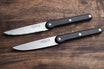
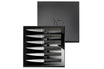
For TB-1648's Expression Damas sets — four knives at €265 with Pakkawood or Olive wood handles — the hardness is in the 52-54 HRC range, positioning these blades in a versatile and easy-to-maintain category. The choice is consistent: Damascus here provides aesthetic value and a performance profile suitable for demanding but non-professional daily use.
Maintenance and Sharpening: Practical Implications
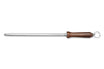
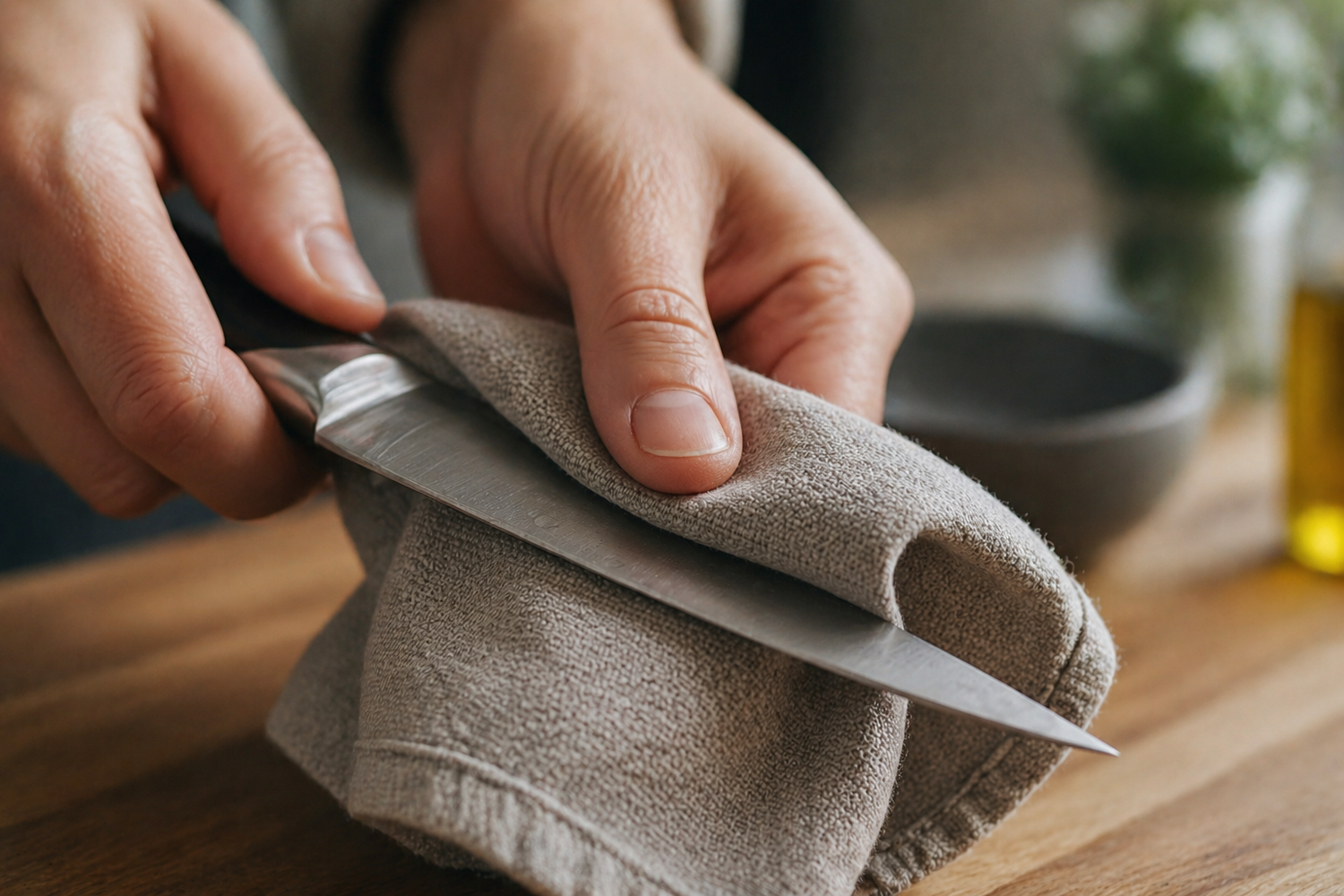
A quality stainless steel at 56-58 HRC is maintained with regular honing, with a full sharpening on a stone once or twice a year depending on the intensity of use. Stainless steel resists moisture well, but dishwashers are still not recommended: thermal cycles and aggressive detergents wear out the steel and handles.
For Damascus steel at 52-54 HRC, the logic is identical. Sharpening is accessible even on a medium-grit stone (1000-3000). The recommended angle is generally around 15 to 20° per side. The Damascus pattern itself does not disappear with use: it is embedded in the mass of the blade, not on the surface. Excessive polishing, however, can attenuate it.
Understanding these parameters allows one to choose a knife suited to their actual practices and to derive maximum lifespan from it — which is, ultimately, the meaning of a well-designed tool.