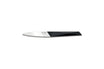
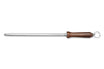

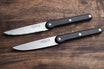
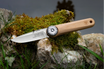
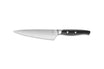
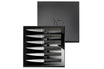

The knife is not merely a kitchen utensil; it has been an extension of man's hand since the dawn of humanity. An object of survival, creation, and sharing, it has naturally shaped our language. In the language of Molière, the sharpness of the blade does not merely cut matter: it chisels our emotions, highlights our tensions, and illustrates our keenness of mind with unparalleled verve.
Why is the knife so present in the French language?
The obsessive presence of the knife in our idioms is explained by the deep history of French cutlery. Since the Middle Ages, the knife was one of the few personal objects that one carried on oneself, often hanging from the belt. It was the indispensable tool of daily life, from defense to the dinner table.
As a custodian of ancestral know-how since 1648, TB-1648 observes that this linguistic omnipresence reflects a sociological reality: the knife is a symbol of power, freedom, but also vulnerability. As the CNRTL emphasizes in its etymological notes, the word "couteau" derives from the Latin cultellus, recalling that the object is above all linked to the land and sustenance. This intimate relationship has given rise to a rich semantics where the cutting edge becomes a metaphor for life itself.
What expressions are related to sharpness and precision?
The sharpness of a blade requires absolute technical mastery. In language, this precision transforms into an evaluation of intellectual rigor or the fragility of a given situation.
“Couper les cheveux en quatre” (To split hairs)
This expression, well known to perfectionists (and their detractors), illustrates precision pushed to excess. If a cutler must demonstrate extreme meticulousness to adjust a blade, one who "splits hairs" gets lost in insignificant details. It is the image of an edge so fine that it attacks the invisible, at the risk of losing sight of the essential subject.
“À la pointe du couteau” (At knifepoint / with extreme determination)
Here, we are no longer talking about subtlety, but determination. To do something "à la pointe du couteau" is to act with surgical precision and an iron will. This demanding standard is found in high-end French cutlery, where every gesture must be assured to achieve aesthetic and functional excellence.
“Sur le fil du rasoir” (On a razor's edge)
The "fil" (edge) is that infinitesimal contact zone between the blade and the material. To be on a razor's edge is to be in a perilous situation where the slightest imbalance can lead to rupture. It expresses precarious balance, the very balance that the blacksmith seeks to stabilize during the final sharpening.
What expressions are related to gesture and use?
The knife is also a weapon and a tool of coercion. The gesture associated with the blade often tells a story of domination, defense, or betrayal.
“Avoir le couteau sous la gorge” (To have a knife at one's throat)
This dramatic metaphor evokes unbearable pressure. It reminds us of a time when the blade was the ultimate negotiating argument. Today, it symbolizes a complete lack of choice or a major financial or moral constraint, highlighting the symbolic power of the knife as an instrument of life or death.
“Un couteau dans le dos” (A knife in the back)
The ultimate betrayal. Unlike a loyal face-to-face confrontation, a stab in the back evokes cowardice. This expression emphasizes that the tool, though inanimate, carries the morality of the one who wields it. In the symbolism of objects, this often aligns with global myths surrounding the blade.
“Mettre les couteaux entre les dents” (To put knives between one's teeth)
Borrowed from the lexicon of piracy or military assaults, this expression means preparing for a fierce battle with ferocious determination. It illustrates the aggression needed to overcome a major obstacle, transforming the everyday utensil into a symbol of savage resilience.
What expressions are related to the table and sharing?
The table is the place of conviviality par excellence, but it is also where the knife acts as an arbiter of sharing and survival.
“Tomber sous le couteau” (To fall under the knife)
Historically linked to sacrifice or butchery, this expression refers to someone who succumbs or is the victim of a sharp and irrevocable decision. At the table, it reminds us that to nourish, one must first cut, an act that is never insignificant in the order of living things.
“Manger à la pointe du couteau” (To eat at knifepoint / with the tip of a knife)
This is a rustic and authentic way of eating one's meal, often associated with shepherds, peasants, or journeymen. To eat this way is to disregard social conventions and return to the primary use of the personal tool. It is a tribute to simplicity, although this use sometimes has to contend with superstitions related to giving or handling a knife.
What do these expressions say about our relationship with the knife?
These phrases reveal that the knife is much more than an assembly of steel and wood. It is a marker of civilization. By using these expressions, we unconsciously recognize that the blade is the tool that separates the civilized from the savage, the precise from the vague, and the traitor from the brave.
At TB-1648, we perceive each expression as a vibrant tribute to the longevity of our craft. If the knife lives so well in our language, it is because it first lived in our hands for centuries, shaping our culinary and social culture from the forges of Thiers to the most prestigious tables.
Frequently Asked Questions
Why is it said that you should not give a knife as a gift?
According to popular tradition, giving a knife as a gift risks "cutting" the bond of friendship or love. To ward off this fate, custom dictates that a small coin be given in exchange, transforming the gift into a symbolic act of sale.
What is the origin of the expression "Swiss Army Knife"?
Initially linked to the multi-tool of the Swiss army, this term today, by extension, refers to a person or object capable of adapting to all situations with formidable versatility and efficiency.
Why is the knife the symbol of the city of Thiers?
As the history of cutlery on Wikipedia indicates, Thiers has been the French capital of cutlery for over six centuries. The hydraulic power of the Durolle river allowed the installation of mills to forge blades whose worldwide renown has nourished our imagination and our vocabulary.