


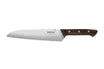


For centuries, knives have held a central place in tales and legends around the world. Far more than mere tools, they are often perceived as objects of power, protection, or even curse. From Norse mythology to Asian fables and Celtic stories, let's explore how knives have been symbolized and portrayed throughout the ages.
Knives, symbols of power and bravery
In many cultures, the knife is associated with strength and courage. Among the Vikings, blades were often forged with runic inscriptions believed to bestow magical power upon their wielder, much like Durandal , Roland's legendary sword, which, despite being a sword, shares a similar essence as a magical artifact and symbol of bravery. Samurai warriors, meanwhile, carried tantos , small knives that symbolized honor and ultimate commitment.
In medieval Europe, Excalibur , though technically a sword, shares symbolic characteristics with mythical knives: it bestows upon its wielder divine power and royal legitimacy. Around the same time, in Norse mythology, Loki's dagger is an instrument of cunning and deception, often used to trigger major events among the gods. Another tragic example is the dagger in the Persian legend of Rostam and Sohrab , where the hero uses a knife unknowingly to kill his own son.
Objects of protection and rituals
In folklore, knives are not only weapons but also tools for protection against evil. In Europe, it was common to plant a knife in the ground around a cradle to protect an infant from evil spirits. Similarly, in some Asian beliefs, a kris , the traditional curved knife, is believed to ward off evil spirits and malevolent entities. Shamans and sorcerers also used blades to draw protective circles or to symbolically sever the ties between an individual and a curse. In Egyptian mythology, the knife of Isis was used in funeral rites to separate the soul from the body and ensure passage to the afterlife.
Knives as instruments of curse
While knives can offer protection, they can also bring ruin. In many legends, they are associated with betrayal and curses. Perhaps the most famous example is Brutus's stabbing of Julius Caesar, a symbol of ultimate betrayal. In Celtic tales, giving a knife as a gift without expecting anything in return was considered a bad omen, as it could sever bonds of friendship or love. This idea of a curse is also found in the Aztec tales of the Dagger of the Heart , where a dagger is used in sacrifices, symbolizing both the end and the curse of a lineage. In Africa, some knives are said to be cursed , passed down from generation to generation, bringing misfortune to their owner.
Conclusion
Whether as a noble weapon, a tool for protection, or a symbol of bad luck, the knife has traversed human history, establishing itself as a fascinating object. Even today, this mystical aura surrounds many exceptional knives, forged according to ancestral traditions and imbued with legendary powers. Artifacts like Excalibur , the Kris , Loki's dagger , and the Dagger of the Heart continue to fuel imaginations and stories across the ages, proving that, despite the centuries, knives remain objects imbued with magic and mystery.